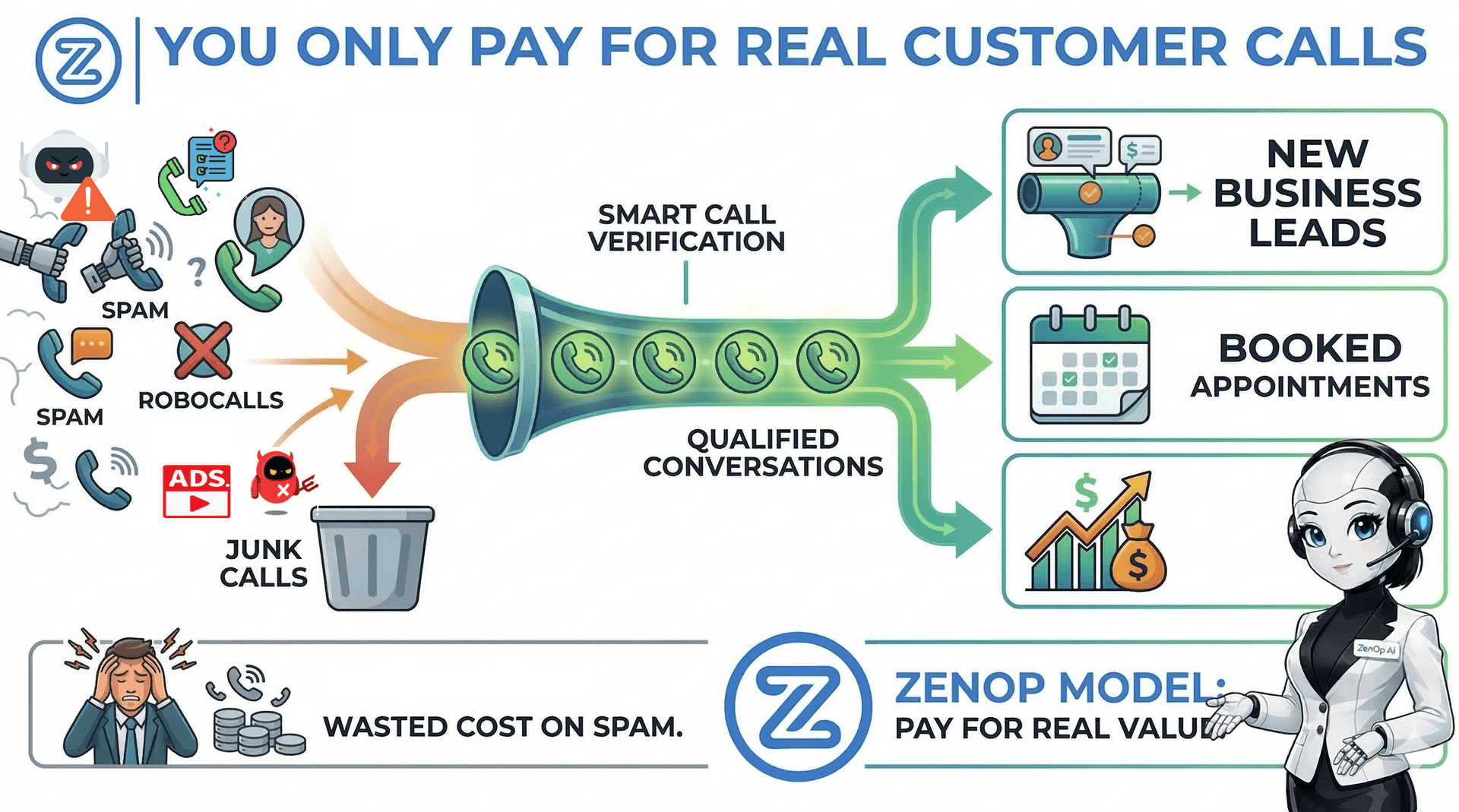
You Only Pay for Real Customer Calls
Spam, robocalls, and wrong numbers should not eat your AI receptionist plan. Learn how modern call filtering works and why legitimate-call-only billing is the standard businesses should expect.
Built for real business phone traffic, not ideal conditions.
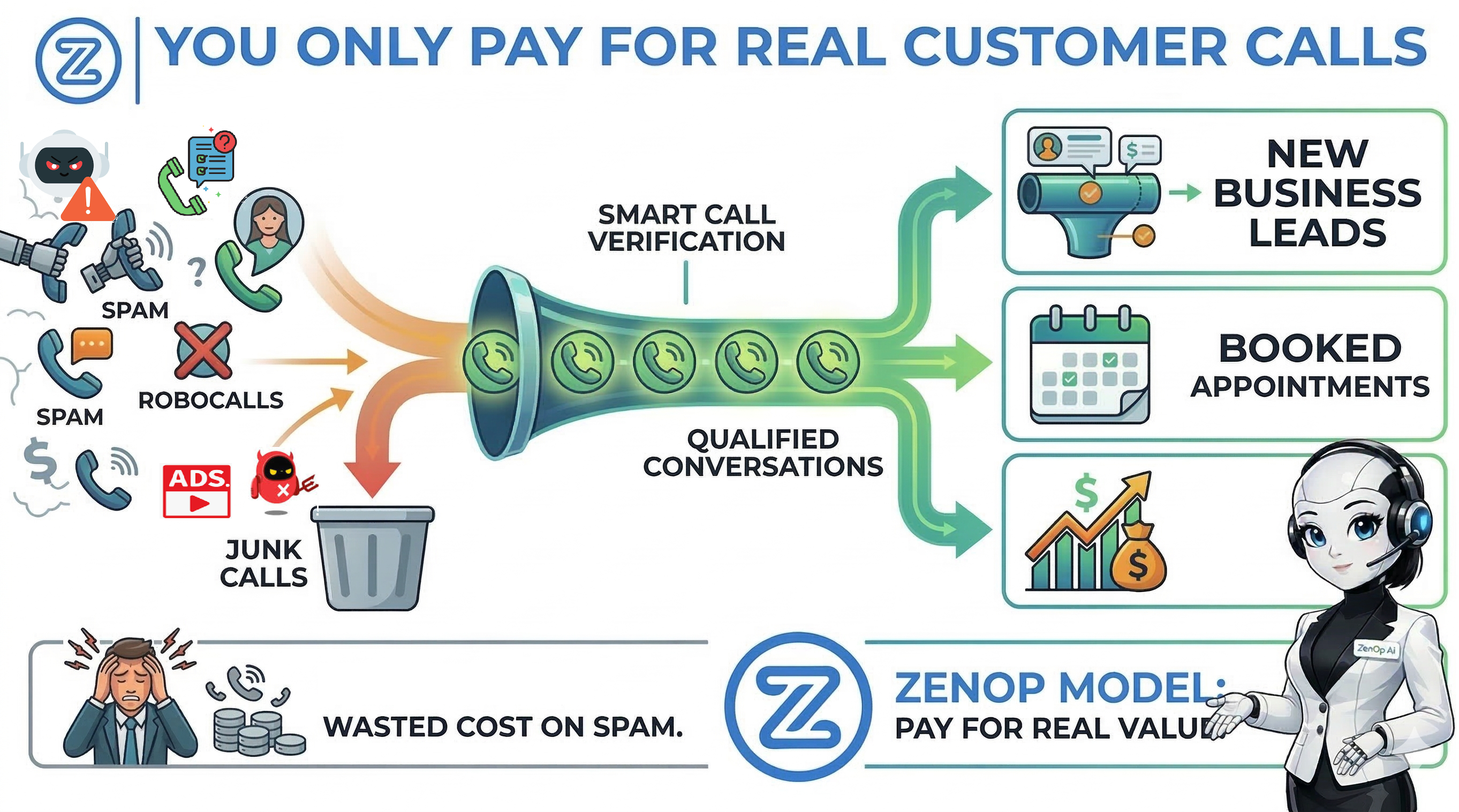
If you run a business that depends on phone calls, you already know the reality:
Not every inbound call is a real opportunity.
Some are legitimate customer calls. Some are appointment requests. Some are returning customers with a quick question.
And some are spam, robocalls, wrong numbers, or low-value junk that has no business counting against your plan.
That distinction matters. A lot.
Because when businesses evaluate an AI receptionist, the question is not just whether it can answer calls. The question is whether it can handle real-world phone traffic in a way that is reliable, efficient, and economically fair.
The answer is a layered filtering system: network-level reputation screening (STIR/SHAKEN), challenge-response gates for suspicious numbers, short-call forgiveness for hangups under 15 seconds, community intelligence from a shared blocklist, and customer controls for fine-tuning. Only real customer conversations count toward your plan.
TL;DR
- Local businesses receive 5-40+ spam/robocalls per day, and those should never count against your AI receptionist plan
- ZenOp uses 5 layers of filtering: network screening, challenge-response, short-call forgiveness, community intelligence, and customer controls
- Spam-screened calls do not count toward your usage, you only pay for real customer conversations
- The AI that handles real calls is powered by the same LLMs behind ChatGPT and Gemini, handling natural conversations with booking, qualification, and follow-up
- Outbound call reputation management ensures your callbacks don't show up as "Spam Likely" on customer phones
The spam problem is bigger than most people think
The FCC estimated that Americans received over 50 billion robocalls in 2024 alone. That is roughly 150 million per day, spread across consumers and businesses alike.
For a local business, a dental office, a law firm, an HVAC company, that translates to anywhere from 5 to 40+ junk calls per day, depending on the industry and the area code.
If every one of those calls counts toward your AI receptionist plan the same way a real customer call does, the economics break fast.
A plumber paying for 200 minutes a month does not want 80 of those minutes consumed by robocallers and political surveys. A salon owner paying per call does not want to subsidize the SEO company that calls every Tuesday at 2pm.
The problem is not hypothetical. It is the daily reality of operating a business phone line.
How modern call filtering actually works
Solving this requires more than just hoping spam does not call. It requires a layered system that catches junk at multiple levels before it ever consumes your plan.
Here is how a well-designed AI receptionist handles it:
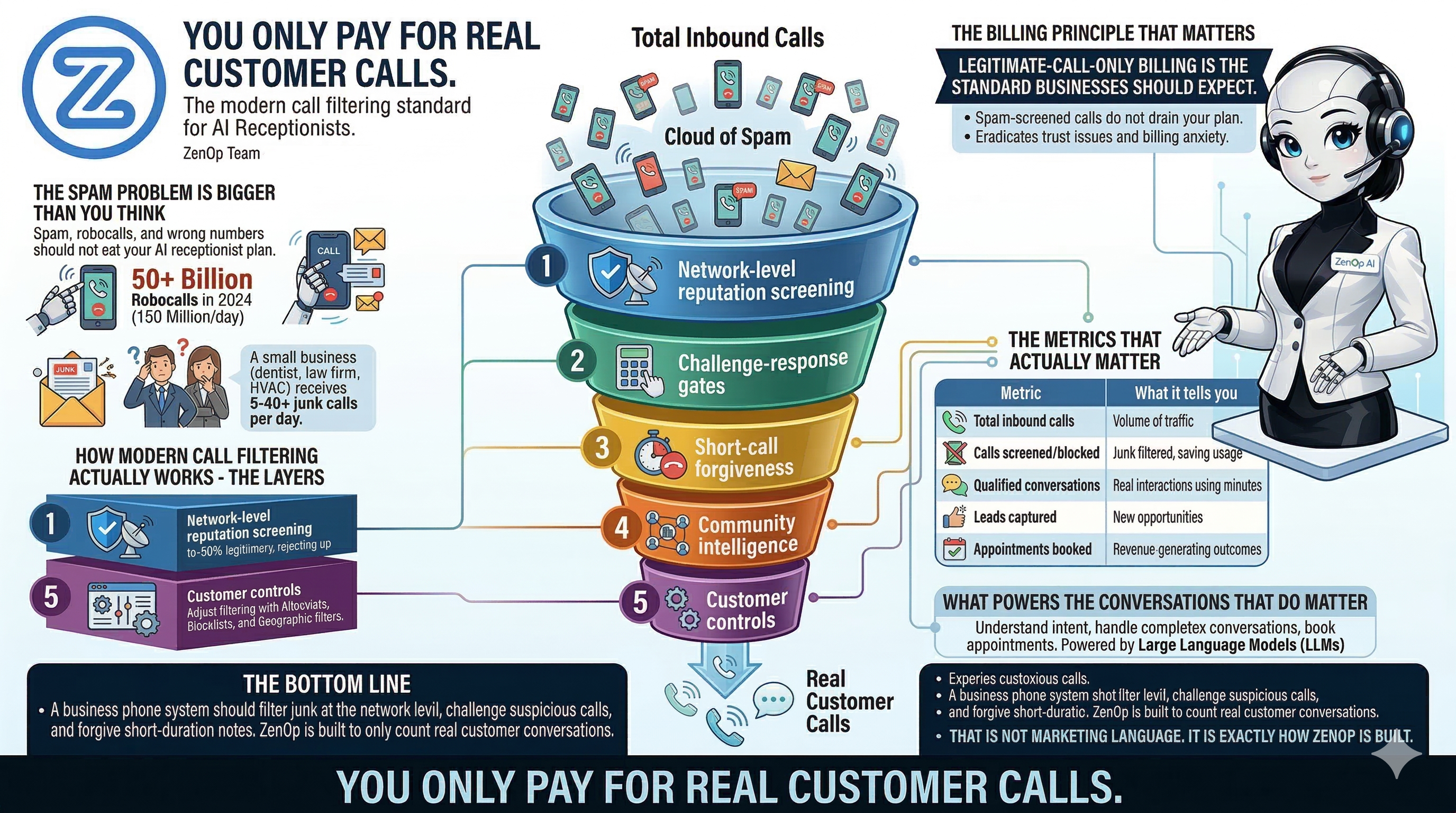
Layer 1: Network-level reputation screening
Before your AI receptionist even picks up, modern telephony infrastructure can check the incoming number against reputation databases, STIR/SHAKEN attestation data, and known spam registries.
STIR/SHAKEN is a set of FCC-mandated protocols that verify whether a caller's displayed number is legitimate or potentially spoofed. If a call arrives with a failed attestation, meaning the number cannot be verified as belonging to the caller, the system can reject it before it reaches your line.
This single layer can eliminate 50-70% of spam before the AI answers.
Layer 2: Challenge-response gates
For calls that pass network screening but still have an unknown or neutral reputation, a lightweight challenge can separate real humans from autodialers:
"Press 1 to reach [Business Name]."
This takes a real caller about one second. But it stops 90%+ of remaining robodialers, because automated systems cannot press buttons or respond to prompts.
It is the same principle behind CAPTCHAs on the web, a trivial task for a human, impossible for a bot.
Layer 3: Short-call forgiveness
Even with network screening and challenge gates, some spam will occasionally slip through. A robocaller might get past screening, hit the AI, and hang up after three seconds.
The right billing approach: do not count it.
Calls under 10-15 seconds are almost never legitimate business conversations. They are hangups, misdials, or spam that connected briefly before disconnecting. A well-designed system automatically excludes these from your usage.
Layer 4: Community intelligence
When one business marks a number as spam, every other business on the platform benefits.
A shared blocklist, where numbers reported by multiple businesses are automatically flagged or blocked across the network, creates a compounding defense that gets stronger as the customer base grows.
This is the same network-effect principle that makes email spam filters improve over time. The more data the system has, the better it gets at distinguishing junk from legitimate callers.
Layer 5: Customer controls
No automated system is perfect, so businesses need the ability to fine-tune their own filtering:
- Allowlists for known customer numbers that should always get through
- Blocklists for repeat offenders
- Mark-as-spam on any call in the dashboard
- Geographic filtering for businesses that only serve local areas
- Stricter after-hours filtering when spam volume tends to spike
These controls give business owners agency without requiring them to become telephony experts.
The billing principle that matters
All of this filtering supports one straightforward idea:
Spam-screened calls should not count toward your plan.
This is not a nice-to-have. It is the standard businesses should expect from any phone-based AI service.
The actual cost of a 5-second spam call hitting the AI is fractions of a cent. The perceived cost to the business owner, the feeling that junk calls are draining their subscription, is enormous. It erodes trust, creates billing anxiety, and makes the entire service feel less valuable.
The best AI receptionist services in the market already operate this way. Smith.ai says spam blocking is enabled by default and clients are not charged for those calls. Other leading services exclude calls under 15 seconds and specifically note that spam or wrong dials are not billed.
It is the right approach. Any service that charges equally for spam and real customers is not aligned with the business owner's interests.
What powers the conversations that do matter
Filtering out junk is only half the equation. The other half is making the most of every real customer call that gets through.
Modern AI receptionists are powered by the same large language models behind ChatGPT and Gemini, models that can understand natural language, follow complex conversational threads, and respond with the kind of nuance that callers expect from a real receptionist.
That means when a real customer calls, the AI can:
- Understand intent, whether they want to book, ask a question, get pricing, or reach a specific person
- Handle multi-turn conversations, not just scripted responses, but genuine back-and-forth dialogue
- Capture leads accurately, collecting name, phone number, email, and the reason for the call
- Book appointments, checking real-time calendar availability and confirming slots
- Answer business-specific questions, using information you provide about your services, hours, pricing, and policies
The latest generation of these models, including GPT-4o and Gemini 2.5, have dramatically improved at understanding accents, handling background noise, managing interruptions, and maintaining natural conversation flow. The gap between AI and human receptionists has narrowed significantly, especially for routine calls.
What about outbound trust?
Filtering inbound spam is critical, but businesses also need their own outbound calls to be trusted.
If a business calls a customer back and shows up as "Spam Likely" on their phone, that is a serious problem. The customer does not answer, the callback fails, and the business loses the opportunity it worked to create.
Maintaining outbound call reputation involves:
- Caller ID (CNAM) registration so the business name displays correctly
- Verified number registration with carrier databases
- Healthy calling patterns, avoiding burst dialing or unusual call volumes
- STIR/SHAKEN compliance on outbound calls so carriers can verify the caller
This is less visible to business owners than spam filtering, but equally important. An AI receptionist that manages both inbound filtering and outbound reputation is protecting the business from both directions.
The metrics that actually matter
At the end of the day, business owners do not care about raw call counts in the abstract. They care about outcomes:
- Did the call become a lead?
- Did it result in an appointment?
- Did it help a customer?
- Did it save the front desk time?
- Did it move the business forward?
A good AI receptionist dashboard should show:
| Metric | What it tells you |
|---|---|
| Total inbound calls | Volume of phone traffic hitting your line |
| Calls screened/blocked | Junk that never reached your plan |
| Qualified conversations | Real customer interactions that used your minutes |
| Leads captured | New opportunities from calls |
| Appointments booked | Revenue-generating outcomes |
When businesses can see the difference between total traffic and qualified conversations, the value of spam filtering becomes immediately concrete. A monthly report showing "ZenOp screened 247 spam calls this month, saving you $XX" transforms an invisible feature into tangible, ongoing value.
The bottom line
A business phone system should not treat spam and real customers as the same thing.
The right standard is simple: filter junk at the network level, challenge suspicious calls, forgive short-duration noise, learn from community data, and give businesses the controls they need.
Then only count real customer conversations against the plan.
That is not marketing language. It is what a well-designed AI receptionist should do, and it is exactly how ZenOp is built.
You only pay for real customer calls.
Frequently Asked Questions
How does spam filtering actually work? ZenOp uses a 5-layer system: (1) network-level STIR/SHAKEN verification blocks spoofed numbers, (2) challenge-response gates stop robodialers, (3) calls under 10-15 seconds are automatically excluded, (4) community blocklists share spam data across all customers, and (5) you can set your own allowlists, blocklists, and geographic filters. Together, these layers eliminate the vast majority of junk calls before they count toward your plan.
Do I get charged for spam calls that slip through? No. Calls that are screened, blocked, or last under 15 seconds do not count toward your usage. You only pay for genuine customer conversations. This is the standard businesses should expect from any phone-based AI service.
What about my outbound call reputation? ZenOp manages outbound call reputation so your callbacks display your business name correctly and don't show up as "Spam Likely." This includes caller ID (CNAM) registration, verified number registration with carrier databases, and STIR/SHAKEN compliance on outbound calls.
How good is the AI at handling real customer calls? The AI is powered by the same large language models behind ChatGPT and Gemini. It understands natural language, handles multi-turn conversations, captures leads accurately, books appointments from real-time calendar availability, and answers business-specific questions. For technical details, see the architecture of AI voice and why latency matters.
Can I see what calls were filtered vs. what counted? Yes. Your dashboard shows total inbound calls, calls screened/blocked, qualified conversations, leads captured, and appointments booked. You can see exactly how much spam filtering saved you each month. Learn more about what your dashboard tracks.
What metrics should I care about? The metrics that matter are qualified conversations, leads captured, and appointments booked, not raw call counts. A good AI receptionist dashboard shows the difference between total traffic and real customer interactions, making the value of spam filtering immediately concrete. See pricing or book a demo.
Get notified when ZenOp launches in your area
We're rolling out across the US. Be the first to know when ZenOp is available for your business.
No spam. Just launch updates.