The Architecture of 24/7 AI Voice: How Modern AI Receptionists Actually Work
Technical deep-dive into the systems that power natural, real-time AI conversations, from speech recognition to language models to voice synthesis.
Technical deep-dive into the systems that power natural, real-time AI conversations
When a customer calls a business and speaks with an AI receptionist, they experience what feels like a simple conversation. Behind that experience lies a sophisticated orchestration of multiple AI systems working in perfect harmony, all within milliseconds.
This article explores the engineering architecture that makes modern AI receptionists possible, not as a sales pitch, but as a technical examination of one of the most demanding real-time AI applications in production today.
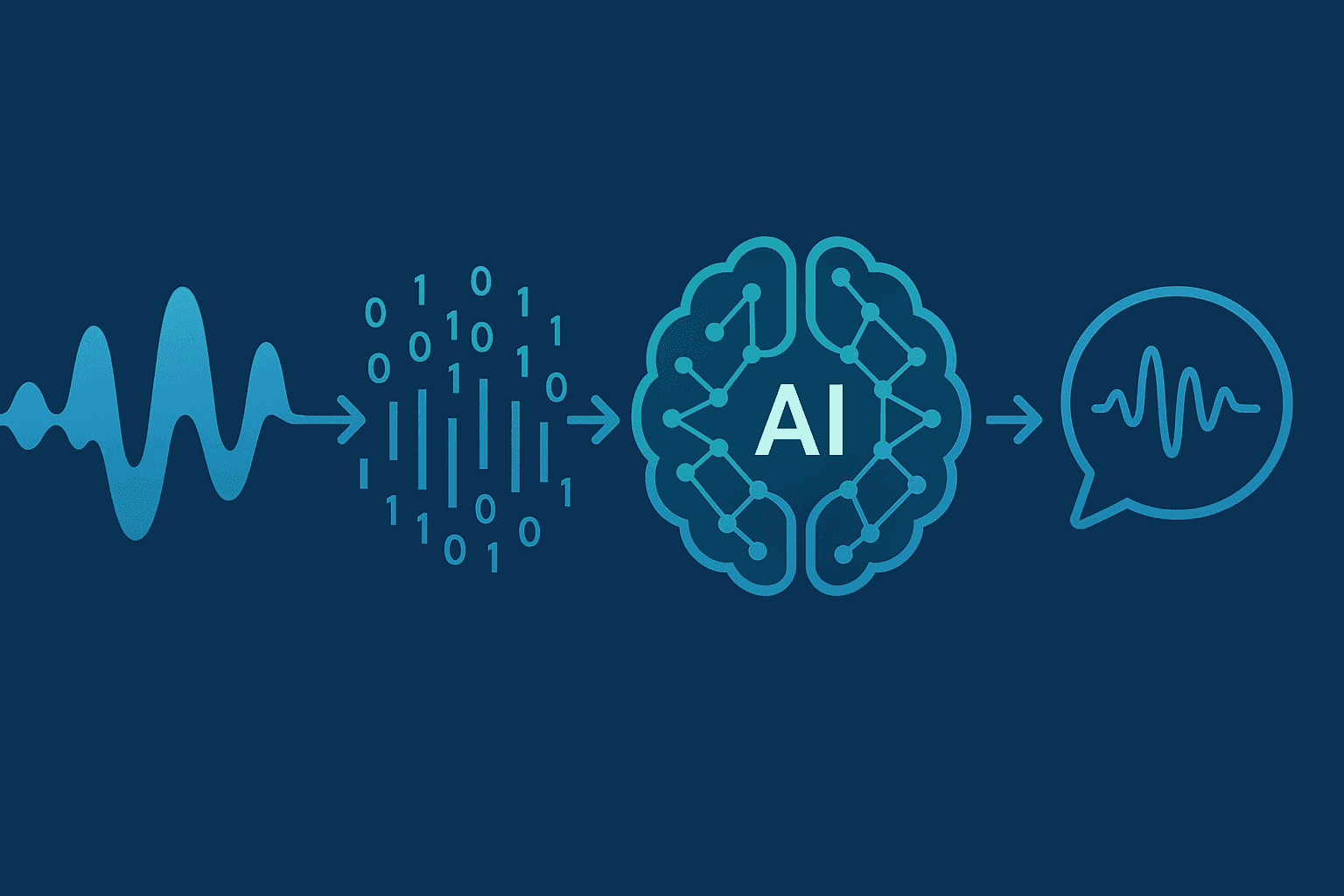
Modern AI receptionists work by orchestrating three systems in real time: streaming speech recognition (converting audio to text), a large language model (understanding intent and generating responses), and streaming speech synthesis (converting text back to natural audio). All three must be co-located in the same data center and connected via streaming pipelines to achieve the sub-600ms voice-to-voice response time that makes conversations feel natural.
TL;DR
- AI voice systems solve three challenges simultaneously: speech-to-text, language understanding, and text-to-speech
- The total latency budget for natural conversation is under 800ms from end of caller speech to start of AI response
- Co-location (running all components in the same data center) is the single most important architectural decision for low latency
- Full-duplex streaming architecture enables the AI to listen while speaking and begin responses before the caller finishes
- Production systems in 2026 achieve 400-600ms response times, 95%+ intent accuracy, and voice quality indistinguishable from humans in blind tests
The Three Pillars of Voice AI
Every AI voice system must solve three fundamental challenges simultaneously:
1. Speech Recognition (Speech-to-Text)
Converting audio waveforms into text is the first step. Modern systems use neural speech recognition that processes audio in real-time streaming mode, not batch processing. The difference matters enormously:
Batch processing: Wait for the speaker to finish → Process entire utterance → Return text
Streaming processing: Process audio as it arrives → Return partial results continuously → Finalize when speaker pauses
Streaming recognition enables the AI to begin formulating responses before the caller finishes speaking. This is essential for achieving conversational latency under 500 milliseconds.
The best modern speech recognition systems achieve:
- Word Error Rate (WER) under 5% for clear speech
- Accurate handling of domain-specific vocabulary (medical terms, industry jargon)
- Robust performance with background noise, accents, and cross-talk
2. Language Understanding and Response Generation
Once speech becomes text, a Large Language Model (LLM) must:
- Understand the caller's intent
- Maintain conversation context across multiple turns
- Generate appropriate, business-specific responses
- Know when to take actions (book appointments, transfer calls, capture information)
The challenge here isn't just accuracy, it's speed. LLMs are computationally expensive. A typical response might require processing millions of parameters. For real-time conversation, this must happen in under 200 milliseconds.
Modern architectures achieve this through:
- Model optimization: Smaller, faster models tuned for conversation
- Speculative decoding: Predicting likely responses before confirmation
- Caching: Pre-computing common conversational patterns
- Co-located infrastructure: Minimizing network latency between components
3. Speech Synthesis (Text-to-Speech)
Converting the AI's text response back into natural-sounding speech is the final step. This is where many AI systems fail to feel "human."
The quality markers for modern TTS:
- Prosody: Natural rhythm, emphasis, and intonation
- Emotion: Appropriate warmth, urgency, or calm based on context
- Streaming output: Begin speaking before the full response is generated
- Low latency: Under 100ms from text to first audio byte
The Latency Budget
For a conversation to feel natural, the total time from when a caller stops speaking to when they hear the AI respond should be under 800 milliseconds. Here's how that budget typically breaks down:
| Component | Target Latency |
|---|---|
| Speech recognition finalization | 150ms |
| Network transit (to LLM) | 50ms |
| LLM processing | 200ms |
| Network transit (to TTS) | 50ms |
| Speech synthesis start | 100ms |
| Audio buffering | 50ms |
| Total | 600ms |
This leaves a 200ms margin for real-world variance. Miss this budget consistently, and callers perceive the AI as "slow" or "robotic."
Co-location: The Secret to Low Latency
The most significant architectural decision in voice AI is co-location, running all three components (STT, LLM, TTS) in the same data center, often on the same network segment.
Why this matters:
- Network round-trips between cloud regions add 50-100ms each
- A distributed architecture with three separate cloud services could add 300ms+ of pure network latency
- Co-located systems can communicate via local network or even shared memory
The best voice AI platforms handle this infrastructure complexity transparently, providing a single API that orchestrates optimally co-located services.
Real-Time Streaming Architecture
Modern AI receptionists use a full-duplex streaming architecture:
Caller Audio → [Streaming STT] → Partial Transcripts → [LLM] → Response Tokens → [Streaming TTS] → AI Audio
     ↑                                                                                              ↓
     └──────────────────────────────── Simultaneous bidirectional audio ────────────────────────────┘
This means:
- The AI can listen while speaking (barge-in detection)
- Response generation begins before the caller finishes
- Audio streams continuously in both directions
Handling the Edge Cases
Production voice AI must handle scenarios that break simpler systems:
Barge-in: When a caller interrupts the AI mid-sentence. The system must:
- Detect the interruption within 200ms
- Stop TTS output immediately
- Begin processing new speech
- Maintain conversation context despite the interruption
Cross-talk: When both parties speak simultaneously. Advanced systems use:
- Echo cancellation to separate audio streams
- Voice activity detection to identify the primary speaker
- Graceful degradation when clarity is impossible
Long pauses: Distinguishing between "thinking" pauses and "finished speaking." Too eager, and the AI interrupts. Too patient, and conversations drag.
Connection quality: Handling packet loss, jitter, and varying audio quality from cell phones, VoIP, and landlines.
Post-Call Intelligence
The conversation is just the beginning. Modern AI receptionists perform post-call processing to extract business value:
- Intent classification: What did the caller want?
- Entity extraction: Names, phone numbers, appointment times, service requests
- Sentiment analysis: Was the caller satisfied, frustrated, urgent?
- Action items: What follow-up is needed?
- Quality scoring: How well did the AI handle the call?
This intelligence feeds into CRM systems, analytics dashboards, and business workflows, turning every call into structured, actionable data.
Reliability at Scale
An AI receptionist that handles thousands of concurrent calls must be:
Highly available: 99.9% uptime means less than 9 hours of downtime per year. For a business phone line, even this may be too much.
Horizontally scalable: Handling 10 calls must use the same architecture as handling 10,000 calls.
Gracefully degrading: When components fail, the system should fall back to voicemail or call forwarding, never to silence.
Observable: Real-time monitoring of latency, error rates, and conversation quality across all active calls.
The Current State of the Art
As of 2026, the best AI receptionist systems achieve:
- Latency: 400-600ms voice-to-voice response time
- Accuracy: 95%+ intent recognition for trained domains
- Naturalness: Indistinguishable from human receptionists in blind tests
- Reliability: 99.95%+ uptime with automatic failover
- Scale: Thousands of concurrent calls per deployment
The technology has crossed the threshold from "impressive demo" to "production-ready business tool."
What's Next
The frontier of voice AI research includes:
- Multimodal integration: Combining voice with visual context (video calls, screen sharing)
- Emotional intelligence: Detecting and responding to caller emotions in real-time
- Personalization: Adapting conversation style based on individual caller history
- Multilingual real-time: Seamless language switching mid-conversation
The architecture foundations described here will support these advances, the streaming, co-located, low-latency infrastructure that makes real-time AI possible.
ZenOp's AI receptionist is built on modern voice AI architecture, engineered for the latency, reliability, and naturalness that local businesses require. Learn more about our approach →
Frequently Asked Questions
How fast does the AI respond during a conversation? The best production systems achieve 400-600ms voice-to-voice response time. This means the AI begins speaking within half a second of the caller finishing their sentence. For context, the average gap between human speakers is 200ms. A 400ms response feels natural to callers. For a deeper dive into latency engineering, see why latency matters.
What makes co-location so important? Every network hop between cloud services adds 50-100ms of latency. A voice AI system with speech recognition, language model, and speech synthesis running in three separate cloud regions could add 300ms+ of pure network delay. Co-locating everything in the same data center eliminates this overhead, which is often the difference between a natural conversation and an awkward one.
Can the AI handle interruptions (barge-in)? Yes. Full-duplex streaming architecture means the AI can listen while it's speaking. When a caller interrupts, the system detects the interruption within 200ms, stops its own audio output immediately, processes the new speech, and responds. This is critical for natural conversation flow.
How accurate is the speech recognition? Modern streaming speech recognition achieves under 5% word error rate for clear speech, with even higher accuracy for common business phrases. Systems are robust against background noise, accents, and varying phone line quality. Domain-specific vocabulary (industry terminology) achieves 98%+ accuracy.
What is post-call intelligence? After each conversation, the AI processes the call to extract structured data: caller intent, contact information, appointment details, sentiment, and action items. This turns every phone call from an ephemeral event into searchable, actionable business data. Read the full breakdown in post-call intelligence.
How does this compare to older phone systems like IVR? IVR ("press 1 for sales") uses rigid menu trees and basic speech recognition limited to specific words. Modern AI receptionists use large language models for genuine multi-turn conversations, handle novel situations, and respond naturally. For the full evolution from answering machines to conversational AI, see from voicemail to voice AI.
Get notified when ZenOp launches in your area
We're rolling out across the US. Be the first to know when ZenOp is available for your business.
No spam. Just launch updates.