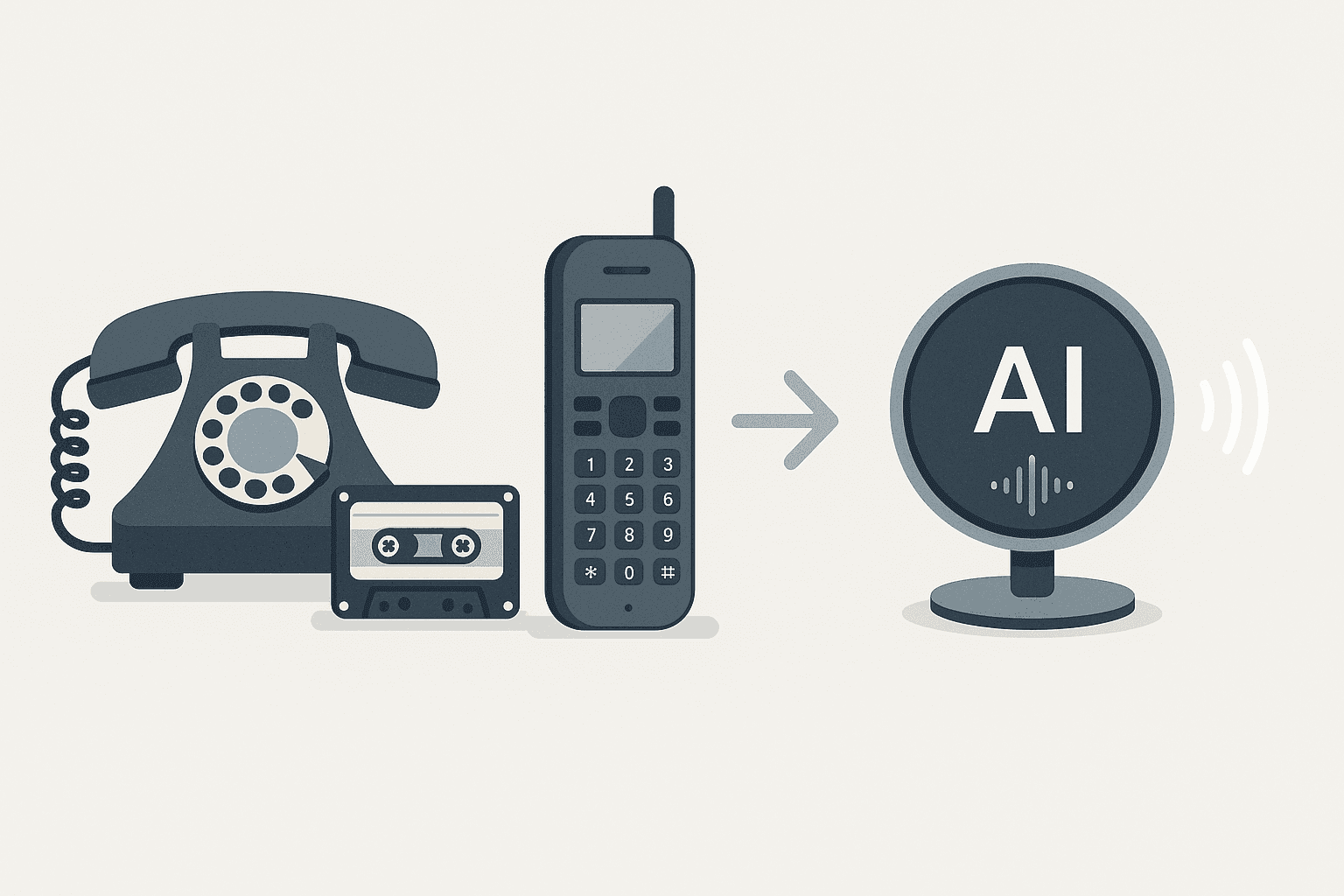
From Voicemail to Voice AI: The Technology Evolution Reshaping Business Communications
A technical history of how we got here, from answering machines to IVR to modern AI receptionists, and where business phone technology is going next.
A technical history of how we got here, and where we're going
The way businesses handle phone calls has transformed fundamentally five times in the past fifty years. Each transformation was driven by new technology that changed what was possible, and what customers expected.
Understanding this evolution isn't just history. It reveals why the current moment matters: we're in the middle of the fifth transformation, and the technology is finally mature enough for mainstream adoption.
We've gone through five eras: answering machines (1970s), IVR phone trees (1990s), basic speech recognition (2000s), virtual assistants like Siri and Alexa (2010s), and now conversational AI powered by large language models (2020s-present). The breakthrough in the current era is sub-600ms voice-to-voice response time with genuine multi-turn conversation ability, made possible by co-located streaming infrastructure that runs speech recognition, language models, and synthesis together.
TL;DR
- Business phone technology has gone through 5 major eras, from answering machines to today's conversational AI
- Previous generations (IVR, basic speech recognition) were designed to deflect calls; modern AI is designed to handle them
- The current era combines large language models (GPT-4, Claude, Gemini) with streaming speech for genuine conversation
- The key technical breakthrough is co-located streaming infrastructure achieving sub-600ms response times
- For local businesses, this means every call answered, every lead captured, at a price point that works for small operations
Era 1: The Answering Machine (1970s-1980s)
Technology: Magnetic tape recording
Capability: Record messages when no one answers
Limitation: No interaction, messages often never retrieved
The answering machine was revolutionary because it solved a binary problem: either someone answers or the caller gets nothing. Now there was a third option.
But the technology was fundamentally passive. It couldn't ask questions, provide information, or take action. Callers left messages; businesses processed them later (maybe).
Technical milestone: Reliable audio recording and playback at consumer price points.
Era 2: Interactive Voice Response (1990s-2000s)
Technology: Dual-Tone Multi-Frequency (DTMF) signaling + pre-recorded audio
Capability: "Press 1 for sales, press 2 for support"
Limitation: Rigid decision trees, frustrated callers
IVR systems made phone systems interactive for the first time. Callers could navigate menus, check account balances, and route themselves to appropriate departments.
The technology was elegant in its simplicity: touch-tone phones send specific frequency pairs for each button. A computer detects these frequencies and responds with pre-recorded audio.
But IVR systems were designed around business convenience, not caller experience. The infamous "phone tree" became a symbol of corporate indifference, a maze designed to deflect calls rather than help callers.
Technical milestone: Real-time audio frequency detection and programmatic call routing.
Era 3: Basic Speech Recognition (2000s-2010s)
Technology: Hidden Markov Models for speech recognition
Capability: "Say 'yes' or 'no'" / "Say the name of the department"
Limitation: Limited vocabulary, frequent misrecognition
Early speech recognition promised to make phone systems more natural. Instead of pressing buttons, callers could speak.
The reality was often worse than IVR. Speech recognition systems of this era could only understand specific words from small vocabularies. They struggled with accents, background noise, and anything beyond their programmed commands.
"I'm sorry, I didn't understand that. Please say 'yes' or 'no'" became the new symbol of frustrating phone systems.
Technical milestone: Real-time speech-to-text for constrained vocabularies.
Era 4: Virtual Assistants (2010s-2020s)
Technology: Deep learning speech recognition + rule-based dialogue management
Capability: Natural language understanding for common requests
Limitation: Breaks down outside trained scenarios, no true conversation
Siri (2011), Alexa (2014), and Google Assistant (2016) demonstrated that natural speech interaction was finally possible. Speech recognition accuracy improved from 80% to 95%+ for clear speech.
These assistants could understand requests, answer questions, and take actions, but only within carefully designed scenarios. Ask something unexpected, and they'd fail gracefully at best, absurdly at worst.
For businesses, this technology enabled better IVR: callers could describe their needs in natural language rather than navigating menus. But true conversation, handling follow-up questions, managing context, dealing with ambiguity, remained out of reach.
Technical milestone: Neural network speech recognition achieving human-level accuracy for clear speech.
Era 5: Conversational AI (2020s-Present)
Technology: Large Language Models + streaming neural speech + managed orchestration
Capability: True multi-turn conversation with reasoning and context
Limitation: Latency optimization, edge cases, integration complexity
The emergence of large language models (GPT-4, Claude, Gemini) created systems that could actually converse. Not navigate menus, not answer canned questions, genuinely engage with novel situations, maintain context, and reason about responses.
Simultaneously, speech synthesis improved from obviously-robotic to genuinely natural. And speech recognition became robust enough to handle real-world audio quality.
But combining these capabilities into a real-time conversation system required solving the latency problem: LLMs are computationally expensive, and any perceivable delay destroys the conversational experience.
The technical breakthrough was co-located streaming infrastructure: running optimized speech recognition, language models, and speech synthesis in tight integration, often in the same data center, with streaming connections that minimize latency at every step.
Technical milestone: Sub-600ms voice-to-voice response time with human-quality conversation.
Why This Moment Matters
Previous generations of phone automation were designed to deflect calls, to reduce the burden on human staff by handling simple queries and filtering complex ones.
Conversational AI inverts this model. The AI isn't a barrier to reaching a human; it's a capable first point of contact that handles most interactions well enough that escalation becomes rare rather than routine.
For local businesses, this is transformative:
Before: Miss a call → Lose the lead
After: Every call answered → Every lead captured
The technology required for this has existed in pieces for years. What's new is the integration: managed platforms that combine speech recognition, language models, and synthesis into turnkey solutions that small businesses can deploy without infrastructure expertise.
The Technical Requirements for Production Voice AI
Making this technology work for real businesses requires solving several challenges:
Reliability
A business phone line must be 99.9%+ available. This requires:
- Redundant infrastructure across multiple availability zones
- Automatic failover to backup systems
- Graceful degradation (to voicemail, to forwarding) when AI is unavailable
Latency Consistency
Median latency matters less than worst-case latency. If 99% of calls are smooth but 1% have multi-second delays, callers experience a frustrating, inconsistent system.
Domain Adaptation
A dental office and a plumbing company use different vocabulary and handle different request types. The AI must be customizable without requiring ML expertise.
Integration
Call data must flow into existing business systems: CRM, scheduling, email. An AI receptionist that doesn't integrate is just a fancy answering machine.
Compliance
Phone calls involve sensitive information. Systems must handle data appropriately, often including call recording consent, PCI compliance for payment information, and HIPAA considerations for medical practices.
The Competitive Landscape
The market has responded to this technology shift:
Enterprise solutions (Nuance, Google CCAI, Amazon Connect) serve large contact centers with complex requirements and correspondingly complex deployments.
Consumer AI assistants (Siri, Alexa, Google Assistant) optimize for smart home control and general information, not business conversations.
SMB-focused AI receptionists (emerging category) specifically address the needs of local businesses: simplicity, reliability, and integration with small business tools.
The technical requirements differ significantly between these segments. Enterprise needs customization and compliance; SMBs need turnkey simplicity. The AI might be similar, but the product around it looks completely different.
What's Next: The Near Future
Several technical advances will reshape this space over the next 2-3 years:
Multimodal Integration
Combining voice with text messaging, web chat, and video into unified conversational threads. A caller who starts on the phone and continues via text should have a seamless experience.
Proactive Engagement
AI that doesn't just answer calls but initiates them: appointment reminders, follow-up calls, satisfaction surveys. The technology exists; the UX and compliance frameworks are still developing.
Emotional Intelligence
Detecting and responding to caller emotions in real-time. An upset caller should receive a different conversational approach than a routine inquiry.
Real-Time Translation
Seamless multilingual conversation without explicit language selection. The caller speaks Spanish; the business owner sees English transcripts; the AI responds in Spanish.
The Long-Term Vision
The ultimate destination is AI that handles business communications as well as the best human staff, not by replacing humans, but by ensuring every interaction, at any hour, meets a high standard.
This requires:
- Continued improvement in language understanding
- Better handling of edge cases and novel situations
- Deeper integration with business operations
- Trust and comfort from both businesses and their customers
The technology trajectory suggests we'll get there. The question is how quickly the market adopts and adapts.
ZenOp was built for this moment, when voice AI technology crossed from "impressive demo" to "production-ready tool." We've architected our system for the reliability, latency, and integration that real businesses require. Learn more →
Frequently Asked Questions
What makes modern AI receptionists different from the old "press 1 for sales" systems? IVR systems used rigid decision trees and pre-recorded audio. Callers navigated menus; the system couldn't handle anything outside its programmed paths. Modern AI receptionists use large language models for genuine conversation. They understand natural speech, handle follow-up questions, manage context across multiple turns, and respond to novel situations. The caller just talks naturally.
How natural does the AI voice sound? Modern text-to-speech achieves Mean Opinion Scores of 4.3/5.0 in blind listening tests (5.0 is indistinguishable from human). The AI handles prosody (rhythm, stress, intonation), appropriate warmth or urgency based on context, and natural pacing. Most callers describe the experience as "professional" and "friendly." See the performance benchmarks.
Is this technology proven for small businesses, or just enterprise? Both. The underlying technology (LLMs, streaming speech) was initially enterprise-only due to infrastructure costs. Modern cloud platforms now amortize this infrastructure across thousands of customers, making it accessible at $150-$550/month. The technology is the same; the product packaging is designed for businesses that answer their own phones. See pricing.
What happens if the AI can't handle a call? The system is designed for graceful degradation. If the AI encounters a situation outside its training, it can transfer the call, take a message, or route to voicemail. During infrastructure outages, calls automatically fall back to voicemail or forwarding numbers. Callers never hear silence. Read about reliability and uptime.
How does the AI learn about my specific business? You provide your business details during setup: services, pricing, hours, service area, FAQs, and any custom information. The AI uses this context for every conversation. It's not generic; it's customized to represent your business accurately. No machine learning expertise required.
What's coming next in voice AI? The near-term roadmap includes multimodal integration (voice + text + web chat in unified threads), proactive engagement (AI-initiated calls for reminders and follow-ups), emotional intelligence (adapting conversation style based on caller mood), and real-time translation for multilingual conversations. For the technical details on current architecture, see the architecture of 24/7 AI voice.
Get notified when ZenOp launches in your area
We're rolling out across the US. Be the first to know when ZenOp is available for your business.
No spam. Just launch updates.