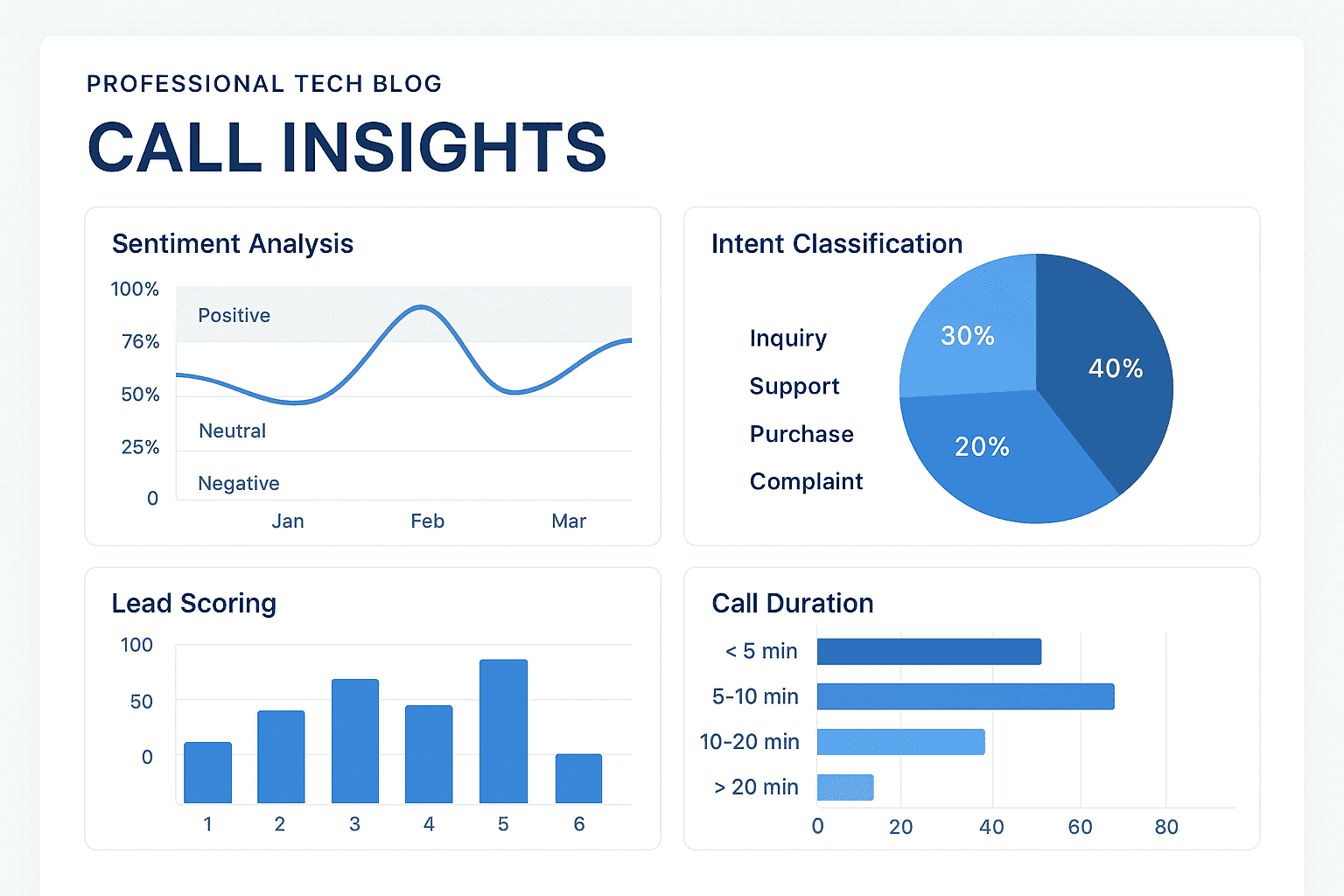
Post-Call Intelligence: How AI Extracts Actionable Insights from Every Conversation
Turning phone calls into structured data that drives business decisions. Learn how AI analyzes conversations to extract intents, entities, sentiment, and action items.
Turning phone calls into structured data that drives business decisions
A phone call is an ephemeral event. Two parties speak, exchange information, and disconnect. What remains?
Traditionally, the answer was "almost nothing." Maybe a voicemail. Maybe a note scribbled on paper. Maybe a memory that fades by the next call.
Modern AI changes this fundamentally. Every phone call can become a structured data asset, searchable, analyzable, and actionable. This article examines the technology behind post-call intelligence and why it matters for business operations.
Post-call intelligence is the process of automatically extracting structured data from every phone conversation. After each call, AI processes the recording through a 6-stage pipeline: transcription, intent classification, entity extraction, sentiment analysis, action item extraction, and quality scoring. The result is a complete, searchable record with caller details, what they wanted, how they felt, and what needs to happen next.
TL;DR
- Every phone call is automatically processed through a 6-stage AI pipeline: transcription, intent classification, entity extraction, sentiment analysis, action items, and quality scoring
- Structured data (caller name, intent, service requested, sentiment, follow-up actions) is available within 60 seconds of call completion
- This data feeds into CRM systems, scheduling tools, analytics dashboards, and alert systems automatically
- Quality scoring enables continuous improvement by flagging calls where the AI underperformed for review
- The result: every call becomes a searchable, actionable business record instead of an ephemeral conversation
The Information Buried in Calls
Consider a typical 3-minute business call. It might contain:
- Caller identification: Name, phone number, existing customer vs. new lead
- Primary intent: What did they want? Appointment, quote, information, complaint?
- Specific requests: "Tuesday afternoon," "two-bedroom," "emergency repair"
- Implicit preferences: Mentioned budget constraints, time urgency, past experiences
- Sentiment signals: Frustrated, pleased, confused, urgent
- Commitments: What was promised? Follow-up call, email, appointment
- Objections: Price concerns, timing issues, competitor comparisons
Without systematic extraction, this information lives only in the memory of whoever took the call, if anyone took it at all.
The Post-Call Processing Pipeline
Modern AI receptionists capture and process this information automatically:
Stage 1: Transcription
The raw audio becomes text. This seems simple but involves significant technical challenges:
Speaker diarization: Distinguishing who said what. The caller's words must be separated from the AI's responses.
Timestamp alignment: Linking text to specific moments in the call for later reference.
Confidence scoring: Identifying words or phrases where transcription may be uncertain.
Formatting: Converting spoken language to readable text (numbers, addresses, spelling).
Modern transcription achieves 95%+ accuracy for clear audio, but phone line quality varies enormously. Systems must handle background noise, poor connections, and overlapping speech.
Stage 2: Intent Classification
What did the caller want? This requires understanding the entire conversation, not just isolated phrases.
Primary intent categories:
- Book an appointment
- Request a quote or estimate
- Ask a question
- File a complaint
- Follow up on previous interaction
- Wrong number or spam
Intent confidence: How certain is the classification? Ambiguous calls should be flagged for human review.
Multiple intents: Many calls involve secondary requests discovered during conversation.
The technical approach uses specialized language models trained on business conversation data. General-purpose LLMs can classify intent, but domain-specific models achieve higher accuracy with lower latency.
Stage 3: Entity Extraction
What specific information did the caller provide?
Contact information:
- Name (with spelling variations)
- Phone number (caller ID vs. stated callback number)
- Email address
- Physical address
Temporal references:
- Requested dates ("next Tuesday," "sometime next week")
- Time preferences ("afternoon," "after 5pm")
- Urgency indicators ("as soon as possible," "not urgent")
Service details:
- Service type requested
- Problem description
- Quantity or scope
- Budget mentions
Entity extraction must handle the messy reality of spoken language. "My number is 555, uh, 1234. No wait, 555-1235" requires parsing corrections and hesitations.
Stage 4: Sentiment Analysis
How did the caller feel during the conversation?
Overall sentiment: Positive, negative, neutral
Sentiment trajectory: Did the call improve or worsen over time?
Specific concerns: What triggered negative sentiment?
Satisfaction indicators: Explicit statements ("this is helpful") and implicit signals (tone, pace)
Sentiment analysis in voice goes beyond word choice. Prosodic features, tone, pace, emphasis, carry emotional information that text analysis misses. Advanced systems analyze both the transcript and the original audio.
Stage 5: Action Item Extraction
What needs to happen next?
Explicit commitments:
- "I'll call you back tomorrow"
- "We'll send a confirmation email"
- "The technician will arrive between 2 and 4"
Implicit follow-ups:
- Quote request → Generate and send quote
- Appointment scheduled → Send confirmation
- Question unanswered → Flag for human follow-up
Urgency classification:
- Immediate action required
- Standard follow-up
- Information only, no action needed
Stage 6: Quality Scoring
How well did the conversation go?
Conversation quality metrics:
- Was the caller's need addressed?
- Were there long pauses or confusion?
- Did the AI misunderstand anything significant?
- Was appropriate information collected?
AI performance metrics:
- Response relevance
- Factual accuracy
- Appropriate escalation decisions
- Conversation efficiency
Quality scores enable continuous improvement. Calls with low scores can be reviewed to identify AI behavior that needs adjustment.
The Data Architecture
Post-call intelligence generates structured data that feeds multiple systems:
Call Record
{
  "call_id": "abc123",
  "timestamp": "2026-01-30T14:23:45Z",
  "duration_seconds": 187,
  "caller_phone": "+1555123456",
  "direction": "inbound",
  "disposition": "completed"
}
Extracted Entities
{
  "caller_name": "Sarah Johnson",
  "intent": "appointment_request",
  "service_type": "dental_cleaning",
  "preferred_date": "2026-02-04",
  "preferred_time": "afternoon",
  "is_new_patient": true
}
Sentiment Analysis
{
  "overall_sentiment": "positive",
  "sentiment_score": 0.78,
  "concerns": [],
  "satisfaction_indicators": ["thanked_ai", "confirmed_understanding"]
}
Action Items
{
  "actions": [
    {
      "type": "send_confirmation",
      "priority": "immediate",
      "details": "Appointment confirmation for Feb 4"
    },
    {
      "type": "new_patient_forms",
      "priority": "standard",
      "details": "Send new patient paperwork"
    }
  ]
}
Integration with Business Systems
Post-call data is only valuable if it flows into operational systems:
CRM Integration
- Create or update contact records
- Log interaction history
- Set follow-up reminders
- Update lead status
Scheduling Systems
- Create appointments from confirmed bookings
- Block calendar time for estimates or consultations
- Send automated confirmations
Analytics Dashboards
- Call volume trends
- Conversion rates (calls → appointments)
- Common inquiry types
- Sentiment trends over time
Alert Systems
- Urgent calls requiring immediate human attention
- Negative sentiment requiring service recovery
- VIP callers flagged for special handling
The Accuracy Challenge
Post-call intelligence is only valuable if it's accurate. Several factors affect reliability:
Transcription errors propagate: If the speech-to-text misheards "Tuesday" as "Thursday," all downstream processing is wrong.
Context matters enormously: "I need someone to come out" means different things for a plumber vs. a realtor.
Ambiguity is common: "As soon as possible" and "whenever is convenient" both express urgency, but very different levels.
Caller behavior varies: Some callers are clear and organized; others ramble and contradict themselves.
Production systems handle this through:
- Confidence thresholds (low-confidence extractions flagged for review)
- Human-in-the-loop verification for critical decisions
- Continuous model improvement based on corrections
Privacy and Compliance
Post-call data processing raises important considerations:
Recording consent: Many jurisdictions require informing callers that calls are recorded. AI receptionists typically include this in their greeting.
Data retention: How long should call data be stored? Balancing business value against privacy principles.
Access controls: Who can view call transcripts and extracted data?
Industry regulations: Healthcare calls (HIPAA), financial services (PCI), and other regulated industries have specific requirements.
Responsible systems provide:
- Clear consent mechanisms
- Configurable retention policies
- Role-based access controls
- Audit logging for compliance
The Business Impact
When every call becomes structured data, new capabilities emerge:
Never lose a lead: Every caller's information is captured, even for calls that don't immediately convert.
Identify trends: Are customer complaints increasing? Are certain services requested more often? Data reveals patterns.
Measure performance: How many calls convert to appointments? What's the average sentiment score? Metrics enable improvement.
Automate follow-up: Instead of relying on memory, systems automatically trigger appropriate next steps.
Train staff: Recorded calls become training material, showing what works and what doesn't.
Looking Forward
Post-call intelligence continues to advance:
Real-time insights: Analysis during the call, not just after. The AI can adjust its approach based on detected sentiment.
Predictive analytics: Which callers are most likely to convert? What's the expected lifetime value of this lead?
Cross-call intelligence: Recognizing returning callers and their history across multiple interactions.
Competitive intelligence: What are callers saying about competitors? What features do they ask about that you don't offer?
The phone call, once an ephemeral event, becomes a persistent, queryable record that informs business decisions.
ZenOp doesn't just answer calls, it transforms them into actionable data. Every conversation is automatically analyzed for intent, sentiment, and follow-up actions, then synced to your dashboard in real-time. See your call intelligence →
Frequently Asked Questions
How quickly is post-call data available? Full transcripts with speaker labels are available within 30 seconds of call completion. Complete intelligence extraction (intent, entities, sentiment, action items) is available within 60 seconds. Data appears in your dashboard within 90 seconds of the call ending. For the full performance benchmarks, see ZenOp by the numbers.
How accurate is the intent classification? Intent classification achieves 96% accuracy across supported industries. The system identifies whether the caller wanted to book an appointment, request a quote, ask a question, file a complaint, follow up on a previous interaction, or was a wrong number/spam. Ambiguous calls are flagged for human review.
What happens with the extracted data? Extracted data flows into your ZenOp dashboard in real time. It can also feed into CRM systems (contact records, interaction history), scheduling systems (appointments, confirmations), analytics dashboards (trends, conversion rates), and alert systems (urgent calls, negative sentiment). Learn more about how this connects to lead capture and SMS follow-up.
How does sentiment analysis work on phone calls? Voice sentiment analysis goes beyond word choice. It analyzes both the transcript and prosodic features of the original audio: tone, pace, emphasis, and other signals that carry emotional information text analysis misses. The system tracks sentiment trajectory (did the call improve or worsen?) and identifies specific concerns that triggered negative sentiment.
What about call recording consent? AI receptionists typically include recording disclosure in their greeting, handling state-specific consent requirements automatically. Data retention is configurable to match your business policies and applicable regulations. Access controls are role-based with audit logging. For more on how the voice system works, see the architecture of AI voice.
Can I use call data for staff training? Yes. Recorded calls with transcripts and quality scores become training material. You can identify calls where the AI or human staff handled situations particularly well (or poorly) and use them as examples. Quality scoring flags calls that need review, creating a continuous improvement loop.
Get notified when ZenOp launches in your area
We're rolling out across the US. Be the first to know when ZenOp is available for your business.
No spam. Just launch updates.