We Studied Small Business Phone Habits: Here's How Many Calls Actually Get Answered
Data from industry research reveals that small businesses miss 40-60% of incoming calls. Here's when they miss the most, what callers do next, and how much it really costs.
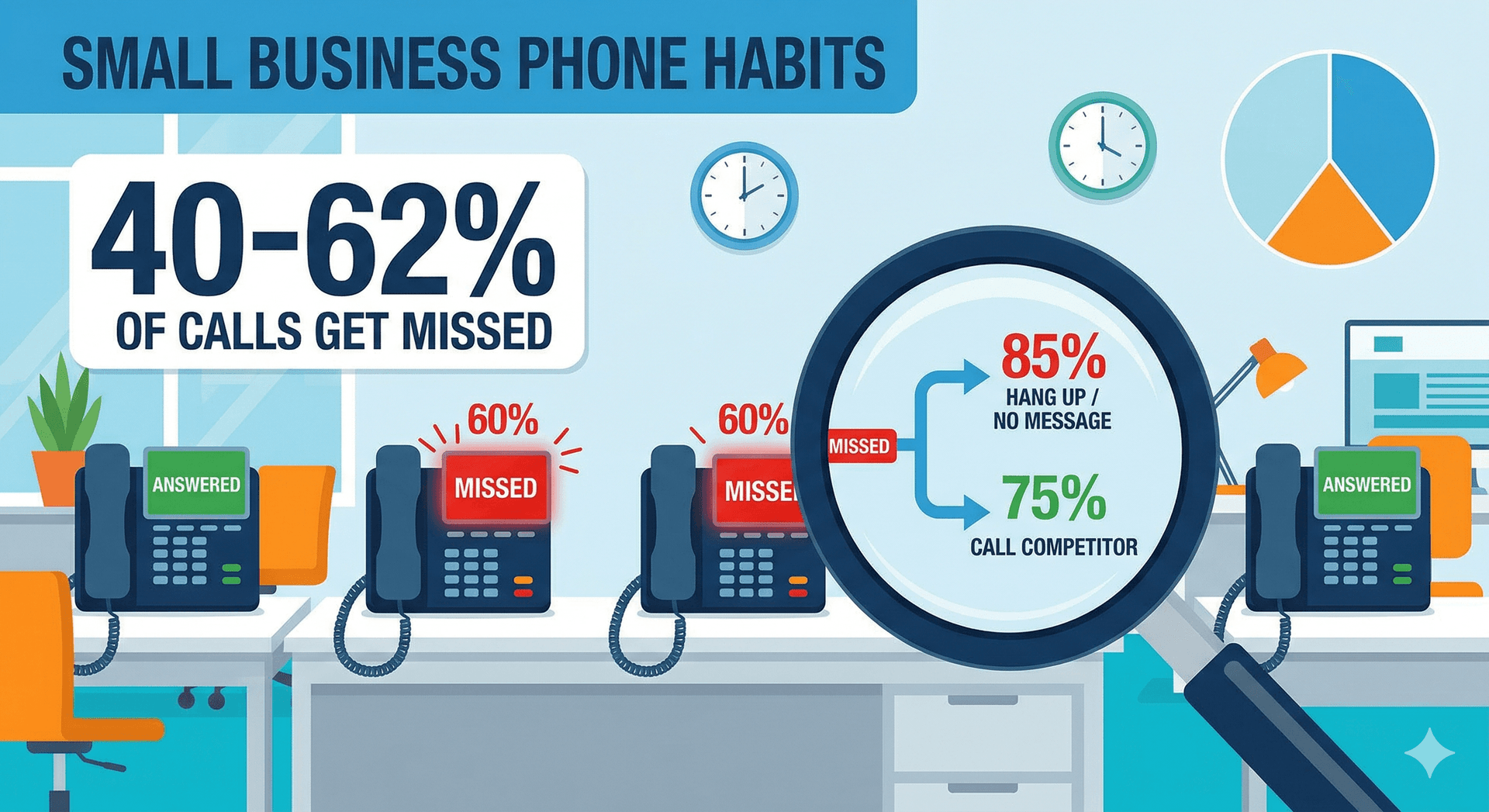
Small businesses miss between 40% and 62% of incoming phone calls, depending on the industry. That is not a guess. That is what the data shows across multiple industry studies, telecom reports, and small business surveys. And the consequences are worse than most owners realize: 85% of callers who reach voicemail will not leave a message, and 75% will call a competitor instead.
This post breaks down the real numbers behind missed calls, when they happen, what callers actually do, and what it costs.
TL;DR
- Small businesses miss 40-62% of incoming calls depending on industry and business size
- Peak missed-call hours are 11:30 AM to 1:30 PM (lunch) and after 5 PM (close of business)
- 85% of callers who reach voicemail hang up without leaving a message
- 75% of callers who cannot reach a business will call a competitor within 5 minutes
- The average missed call costs a small business between $200 and $1,200 in lost revenue
- Businesses that answer within 3 rings convert 30-50% more callers than those that answer after 5+ rings
How Many Calls Do Small Businesses Actually Miss?
The numbers vary by industry, but the pattern is consistent: small businesses miss a lot of calls.
| Industry | Estimated Missed Call Rate | Primary Reason |
|---|---|---|
| Plumbing / HVAC | 55-65% | Technicians on job sites, cannot answer |
| Dental offices | 30-40% | Front desk overwhelmed during patient hours |
| Law firms (solo/small) | 45-55% | Attorneys in court or meetings |
| Salons / barbershops | 50-60% | Staff with clients, hands occupied |
| Auto repair shops | 55-65% | Mechanics under vehicles, shop noise |
| Real estate agents | 40-50% | Showings, driving, client meetings |
| General contractors | 50-60% | Active job sites, no front desk |
| Gyms / fitness studios | 35-45% | Staff on the floor during peak hours |
Sources: Forbes Small Business Survey 2024, Invoca Call Intelligence Report, BIA/Kelsey Local Commerce Monitor, Ruby Receptionist Industry Benchmark.
The common thread? It is not that business owners do not care about their phones. It is that they are physically busy doing the work that pays the bills. A roofer cannot answer the phone from a ladder. A dentist cannot take a call mid-filling. A hairdresser cannot pick up with foils in a client's hair.
When Do Most Missed Calls Happen?
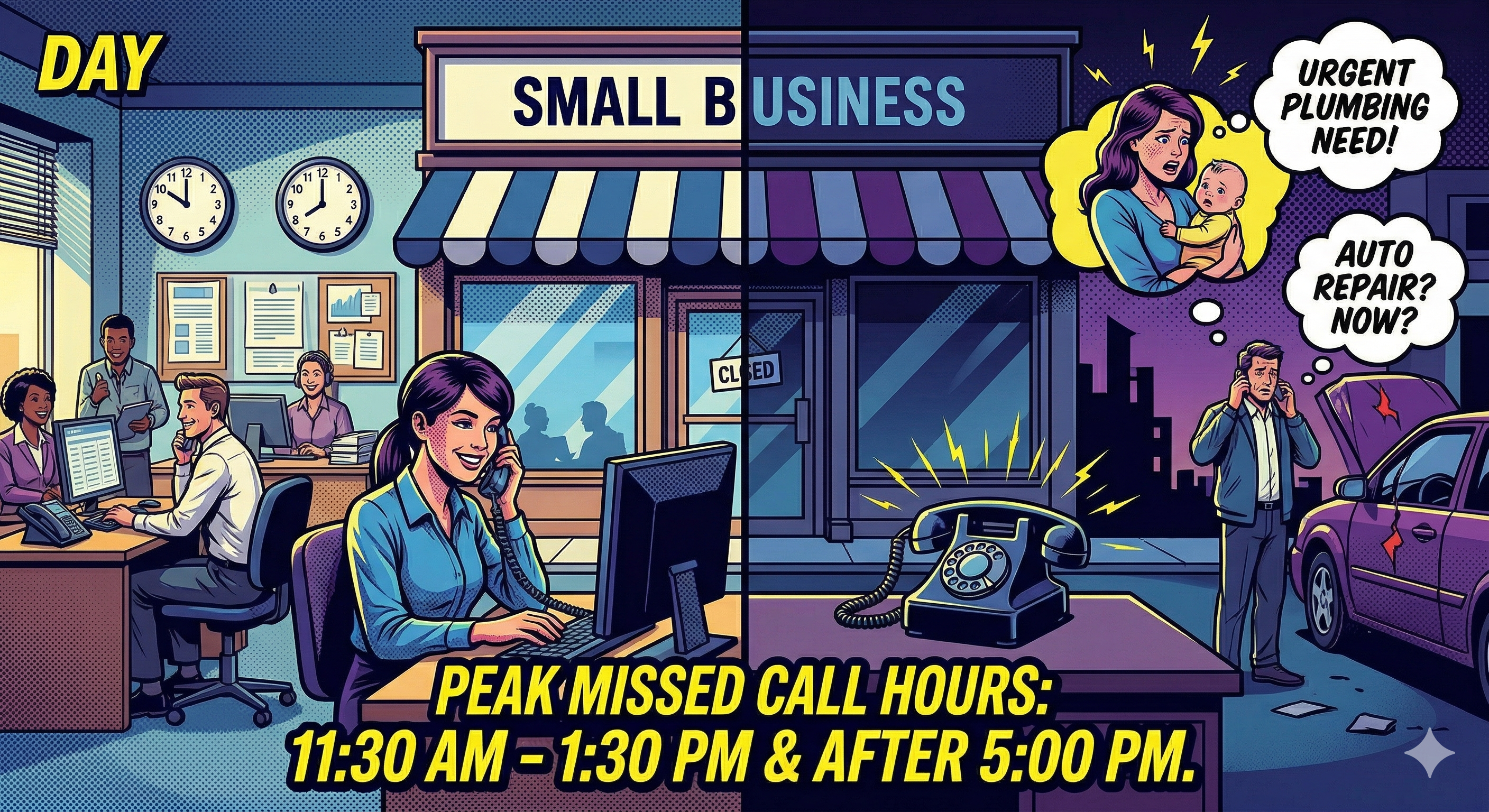
Missed calls are not random. They cluster around predictable windows.
Peak missed-call windows
| Time Window | Why Calls Get Missed | Caller Intent Level |
|---|---|---|
| 7:00-9:00 AM | Business not yet open, staff arriving | High (morning planners, urgent needs) |
| 11:30 AM-1:30 PM | Lunch break, skeleton staff | High (lunch-break callers, quick decisions) |
| 4:30-6:00 PM | End of day, wrapping up, staff leaving | Very high (last-chance callers before evening) |
| 6:00-9:00 PM | Business closed | Highest (people calling after their own work day) |
| Weekends | Business closed or reduced hours | High (homeowners with free time to research) |
The most painful insight: the hours when businesses miss the most calls are the hours when caller intent is highest.
Someone calling at 7:30 PM is not browsing. They need something. Their pipe burst. Their tooth hurts. They want to book before they forget. These are the highest-value calls, and they are the most likely to go unanswered.
Research from BIA/Kelsey shows that 35-40% of all calls to local businesses happen outside traditional business hours. That is over a third of your phone leads arriving when nobody is there.
What Do Callers Actually Do When Nobody Answers?
This is where the data gets uncomfortable.
Caller behavior after reaching voicemail
| Caller Action | Percentage | Source |
|---|---|---|
| Hang up without leaving a message | 80-85% | Forbes / Invoca |
| Call the next business on Google | 70-75% | BIA/Kelsey |
| Leave a voicemail and wait | 15-20% | Invoca Call Intelligence |
| Call back later the same day | 20-30% | Ruby Receptionist |
| Call back the next day or later | Less than 10% | Ruby Receptionist |
| Never call back at all | 60-70% | Multiple sources |
The math is brutal. If 100 people call your business and 50 go to voicemail:
- 42 hang up without a message (you never know they called)
- 37 call a competitor (your loss is someone else's gain)
- 10 leave a voicemail (which you might check hours later)
- 6 might try you again tomorrow (but most will not)
That is not a "phone problem." That is a revenue leak running 24 hours a day.
The Speed Factor: How Fast You Answer Matters
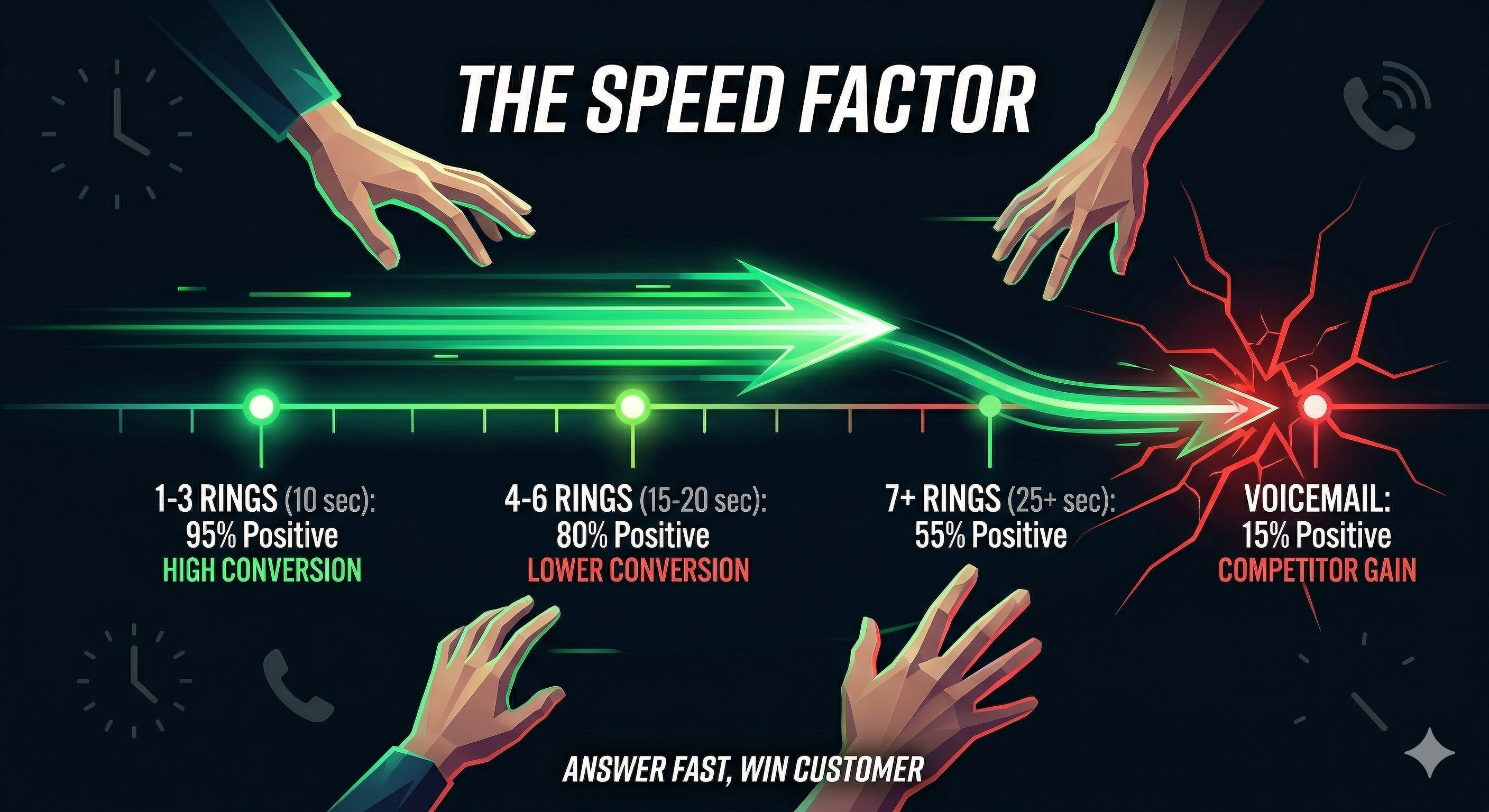
It is not just about answering. It is about answering fast.
| Answer Speed | Caller Satisfaction | Conversion Impact |
|---|---|---|
| Within 3 rings (10 sec) | 95% positive | Baseline conversion rate |
| 4-6 rings (15-20 sec) | 80% positive | 10-15% lower conversion |
| 7+ rings (25+ sec) | 55% positive | 25-35% lower conversion |
| Voicemail | 15% positive | 80-90% lower conversion |
Data from Marchex and Invoca shows that callers who wait more than 20 seconds before someone answers are significantly less likely to book an appointment or commit to a purchase. By the time they hear your voicemail greeting, most have already decided to try someone else.
The first business to answer wins the customer. Not the cheapest. Not the best reviewed. The first one that picks up the phone.
How Much Does a Missed Call Actually Cost?
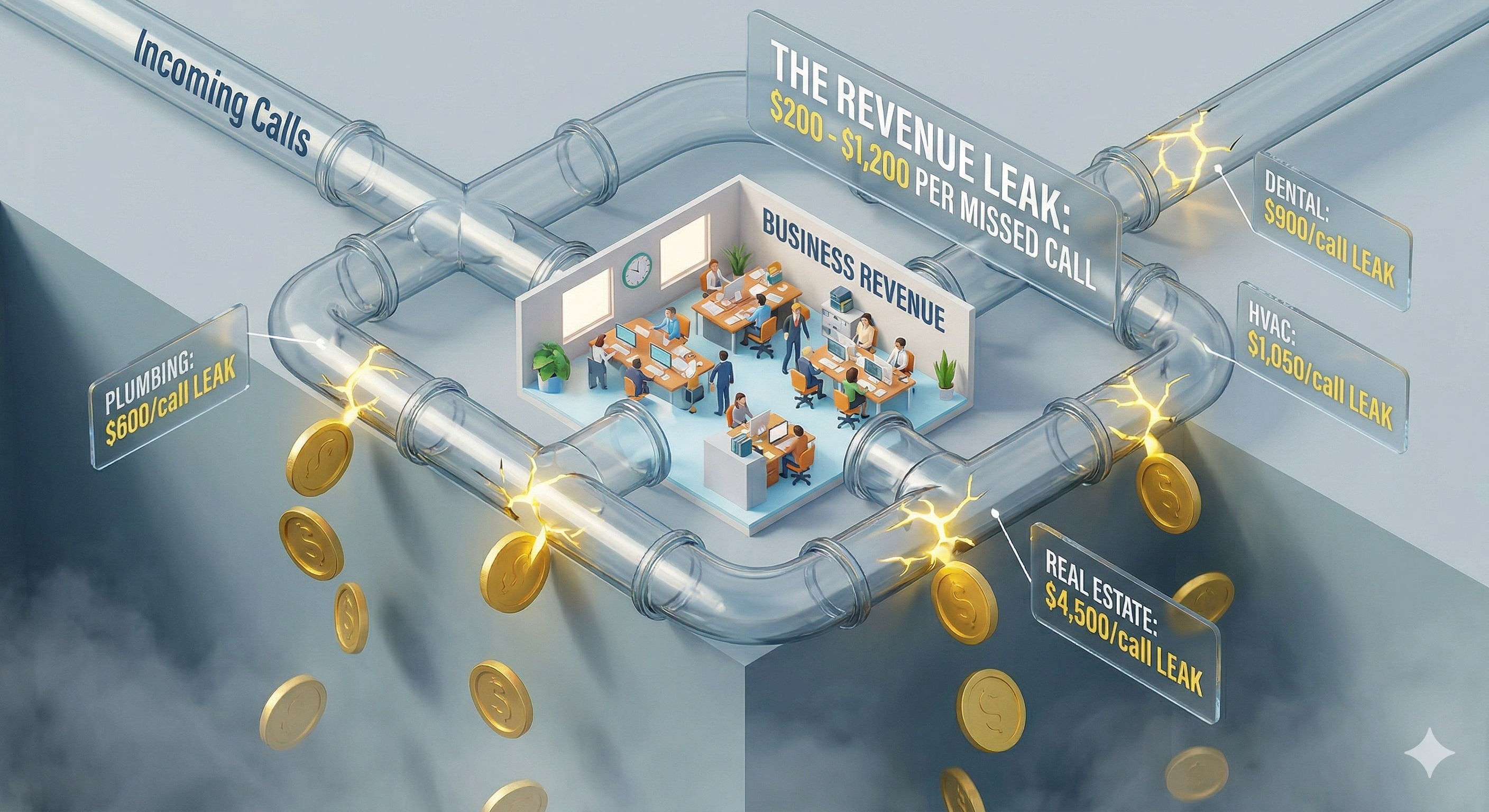
We covered this in detail in how much does a missed call cost your business, but here is the summary by industry:
| Industry | Avg Customer Value | Missed Call Cost (single call) | Monthly Cost (15 missed calls) |
|---|---|---|---|
| Plumbing | $800-$2,000/job | $240-$600 | $3,600-$9,000 |
| Dental | $1,500-$3,000/yr | $450-$900 | $6,750-$13,500 |
| HVAC | $1,200-$3,500/yr | $360-$1,050 | $5,400-$15,750 |
| Law firm | $3,000-$10,000/case | $900-$3,000 | $13,500-$45,000 |
| Real estate | $5,000-$15,000/deal | $1,500-$4,500 | $22,500-$67,500 |
| Salon/spa | $1,000-$2,500/yr | $300-$750 | $4,500-$11,250 |
| Auto repair | $500-$1,500/visit | $150-$450 | $2,250-$6,750 |
| General contractor | $2,000-$10,000/job | $600-$3,000 | $9,000-$45,000 |
Formula: Missed Call Cost = Average Customer Value x Conversion Rate (30%) x Miss Rate
These are not worst-case scenarios. These are median estimates based on typical customer lifetime values and industry conversion rates.
And this does not include the compounding losses: the referrals that customer would have sent, the reviews they would have left, the repeat business over years. One missed call is never just one missed call.
The Voicemail Myth
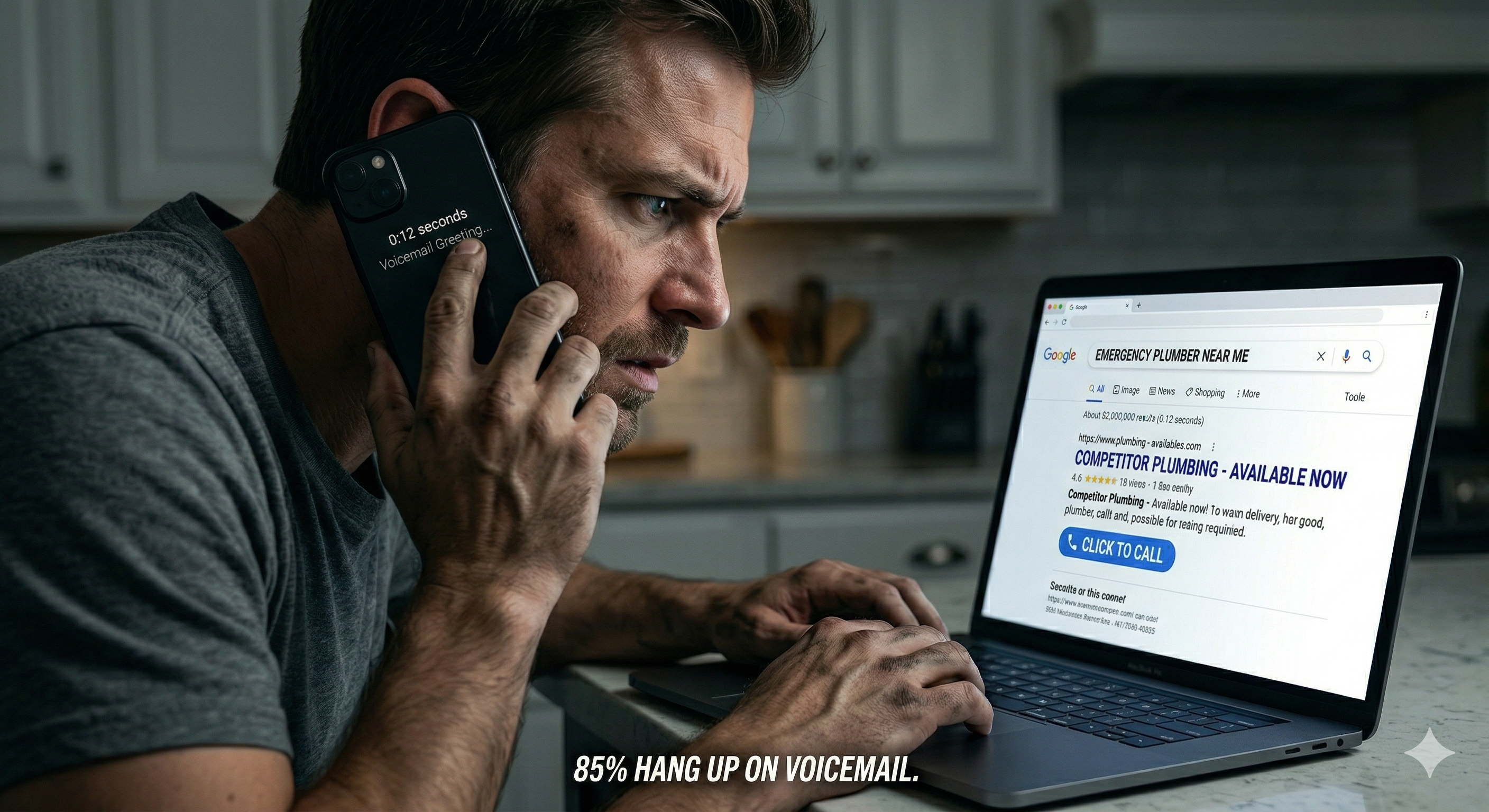
Most small businesses believe voicemail is an acceptable backup. The data says otherwise.
What business owners think happens
- Customer calls
- Customer leaves a voicemail
- Business calls back within a few hours
- Customer is still interested
- Business books the appointment
What actually happens
- Customer calls
- Customer hears the voicemail greeting (average: 25-45 seconds long)
- Customer hangs up at second 8-12 (before the greeting even finishes)
- Customer Googles the next business
- Customer calls competitor
- Competitor answers
- Customer books with competitor
- Business owner checks voicemail at 6 PM, sees zero messages, thinks "slow day"
The business owner never knows the call happened. There is no missed-call notification for most landline and VoIP systems. The customer is gone, and the business has no idea.
Research from Marchex found that the average time a caller waits before hanging up on a voicemail greeting is 8-12 seconds. Most business voicemail greetings are 25-45 seconds long. The caller is gone before the beep.
The After-Hours Gap
This is the single biggest opportunity most small businesses are ignoring.
35-40% of calls to local businesses happen outside 9 AM-5 PM business hours. For service businesses (plumbers, electricians, HVAC), that number climbs to 45-50% because homeowners call after they get home from work and discover the problem.
| Time Period | % of Total Calls | Typical Handling | Result |
|---|---|---|---|
| 9 AM-5 PM (business hours) | 55-65% | Staff answers (sometimes) | Some get answered |
| 5 PM-9 PM (evening) | 20-25% | Voicemail | Almost all lost |
| 9 PM-7 AM (overnight) | 5-10% | Voicemail | All lost |
| Weekends | 10-15% | Voicemail or reduced staff | Most lost |
The evening window (5-9 PM) is where the most money disappears. These are high-intent callers: homeowners who just got home, noticed a problem, and are ready to book. They are calling with a credit card in hand. And they are hearing your voicemail.
For a deeper look at this problem, read after-hours call answering for small businesses.
What "Answering Every Call" Actually Looks Like
The solution is not "hire more staff." Most small businesses cannot afford a full-time receptionist ($35,000-$45,000/year), and part-time help does not solve the after-hours problem.
The realistic options:
| Solution | Cost | Hours Covered | Booking Capability | Follow-Up |
|---|---|---|---|---|
| Voicemail | Free | None (just records) | No | No |
| Part-time receptionist | $1,500-$2,500/mo | 20-30 hrs/week | Manual only | No |
| Full-time receptionist | $3,000-$4,000/mo | 40 hrs/week | Manual only | No |
| Traditional answering service | $200-$600/mo | Business hours or 24/7 | Rarely | Rarely |
| AI receptionist | $150-$550/mo | 24/7/365 | Automatic | Automatic |
The gap in the market is obvious: before AI receptionists, there was no affordable way to answer every call, book appointments automatically, and follow up by text. You either paid for a human (expensive) or accepted voicemail (lossy).
For a detailed breakdown, read AI receptionist vs answering service or AI receptionist vs voicemail.
Key Takeaways for Small Business Owners
-
You are missing more calls than you think. Without a call tracking system, you have no visibility into calls that go to voicemail and hang up. The problem is invisible.
-
Your highest-value calls come at the worst times. After hours, lunch breaks, and weekends are when the most motivated callers are trying to reach you.
-
Voicemail is not a safety net. It is a trapdoor. The vast majority of callers will never leave a message and will never call back.
-
Speed matters more than perfection. Answering in 10 seconds with a simple greeting converts better than answering in 30 seconds with a polished pitch.
-
The first business to answer wins. Not the cheapest, not the best reviewed, not the most experienced. The one that picks up the phone.
-
The math works against you every day. Even at conservative estimates, 15 missed calls per month at a 30% conversion rate and a $1,000 average customer value is $4,500 in lost revenue per month.
Frequently Asked Questions
How do I know how many calls I am actually missing?
Most phone systems (landline, VoIP, mobile) show missed calls, but they do not show callers who hung up before voicemail, or callers who reached voicemail and left no message. The only way to get full visibility is to use a call tracking or answering system that logs every incoming call. Many business owners are shocked when they see the real numbers for the first time.
Is 62% missed calls really accurate?
The 62% figure comes from a widely cited small business communications study. Your actual number depends on your industry, business size, and staffing. Service businesses with technicians in the field tend to miss more. Businesses with a dedicated front desk tend to miss fewer. The range across industries is 30-65%.
What time of day do most customers call?
For most local businesses, the highest call volume is between 9 AM and 11 AM, with a secondary peak between 4 PM and 6 PM. However, the highest missed-call rate is during lunch (11:30 AM-1:30 PM) and after 5 PM. This creates a mismatch: calls arrive when you are least available to answer them.
How quickly do callers give up?
Research from Marchex shows the average caller waits 8-12 seconds before deciding to hang up or wait for voicemail. If your phone rings more than 4-5 times, a significant percentage of callers have already started thinking about calling someone else.
What is the most cost-effective way to stop missing calls?
An AI receptionist provides the best cost-to-coverage ratio for most small businesses. At $150-$250/month, it covers 24/7 answering, appointment booking, lead capture, and text follow-up. Compared to hiring staff ($3,000-$4,000/month) or a traditional answering service ($200-$600/month with limited capabilities), the ROI is typically 10-40x the monthly cost.
Do these statistics apply to businesses that use VoIP or only landlines?
The data applies to all phone types. Whether you use a traditional landline, VoIP system, or mobile phone, the caller behavior is the same. Callers do not know or care what type of phone you have. They care whether someone answers.
Want to stop losing calls?
ZenOp answers your business phone 24/7, books appointments, and texts callers back automatically. Works with your existing number. Setup takes 5 minutes.
Start your free trial or call (760) 993-6677 to hear it live.
Get notified when ZenOp launches in your area
We're rolling out across the US. Be the first to know when ZenOp is available for your business.
No spam. Just launch updates.