How Much Does a Missed Call Cost a Small Business? The Real Numbers
A single missed call can cost a small business $200 to $10,000+ in lost revenue. See the real math by industry, plus how to calculate your own missed-call cost.
The data behind every ring that goes unanswered
A single missed call costs a small business between $200 and $10,000+ in lost revenue, depending on the industry. For a dental practice, one unanswered call from a prospective patient could mean losing $1,500 to $3,000 in annual revenue. For a law firm, it could be a $10,000 case that walks out the door. These aren't hypothetical numbers. They come from multiplying real conversion rates against real customer values across dozens of industries.
The worst part? Industry research shows that 62% of calls to small businesses go unanswered. That means the majority of people calling your business right now are hearing a ring tone, then silence, then your competitor's voice.
TL;DR
- A single missed call costs between $200 and $10,000+ depending on your industry and average customer value
- 62% of calls to small businesses go unanswered, and 85% of those callers won't leave a voicemail
- 75% of callers who can't reach you will call a competitor instead
- The true cost compounds: you lose not just one sale, but the customer's lifetime value, their referrals, and their online reviews
- Use this formula to calculate your cost: Missed Calls per Month x Conversion Rate x Average Customer Value = Monthly Revenue Lost
The Formula: Calculate YOUR Missed-Call Cost

Before diving into industry benchmarks, here's how to calculate what missed calls are costing your specific business:
Monthly Revenue Lost = Missed Calls x Conversion Rate x Average Job/Customer Value
Here's how to find each number:
- Missed calls per month: Check your phone system or carrier dashboard. If you don't track this, a safe estimate is 30-40% of your total inbound calls.
- Conversion rate: What percentage of answered calls turn into paying customers? For most service businesses, this is 20-40%.
- Average customer value: What does one new customer bring in? Include both the initial job and any repeat business within the first year.
Example: A Plumbing Company
- 200 inbound calls per month
- 62% missed = 124 missed calls
- 30% would have converted = 37 lost customers
- Average job value of $1,200
- Monthly loss: $44,400
Even if you cut that estimate in half to be conservative, that's still over $22,000 per month walking out the door.
Example: A Dental Practice
- 150 inbound calls per month
- 62% missed = 93 missed calls
- 25% would have converted = 23 lost patients
- Average patient value of $2,000/year
- Monthly loss: $46,000 in annual patient value
The math is uncomfortable. But it's also why solving this problem has such a massive ROI.
Cost of a Missed Call by Industry
The table below shows estimated per-call cost ranges based on industry-average customer lifetime values and typical conversion rates from phone inquiries.
| Industry | Avg. Customer Value | Conversion Rate | Cost Per Missed Call |
|---|---|---|---|
| Dental practice | $1,500 - $3,000/year | 25-35% | $375 - $1,050 |
| Plumbing | $800 - $2,000/job | 30-40% | $240 - $800 |
| HVAC | $1,200 - $3,500/year | 25-35% | $300 - $1,225 |
| Law firm | $3,000 - $10,000/case | 15-25% | $450 - $2,500 |
| Real estate | $5,000 - $15,000/commission | 10-20% | $500 - $3,000 |
| Gym/fitness | $600 - $1,200/year | 30-40% | $180 - $480 |
| Salon/spa | $1,000 - $2,500/year | 30-40% | $300 - $1,000 |
| General contractor | $2,000 - $10,000/job | 20-30% | $400 - $3,000 |
| Auto repair | $500 - $1,500/year | 30-40% | $150 - $600 |
| Veterinary clinic | $800 - $2,000/year | 25-35% | $200 - $700 |
Note: "Cost Per Missed Call" = Average Customer Value x Conversion Rate. Real-world figures will vary based on your market, pricing, and sales process.
The ranges are wide because businesses vary. But even the low end of each range adds up fast when you're missing dozens of calls per month.
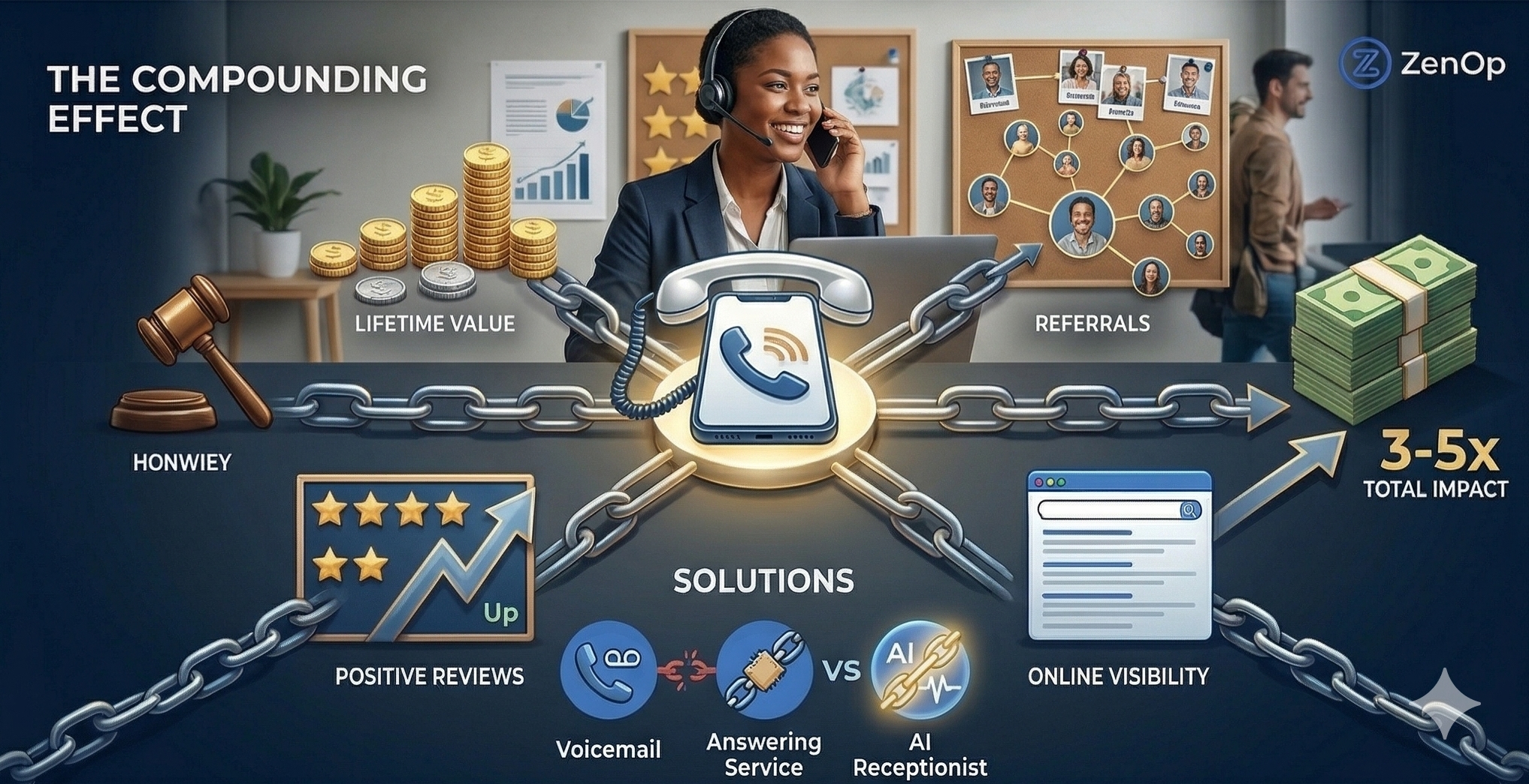
The Compounding Effect: It's Never Just One Call

The numbers above only capture the initial transaction. The real damage goes much deeper.
Lifetime value. A dental patient who stays for 5 years is worth $7,500 to $15,000. A loyal HVAC customer who calls you every season for a decade is worth $12,000 to $35,000. That one missed call didn't cost you $300. It cost you thousands over years you'll never get back.
Referrals. A happy customer refers 2-3 people on average. Each of those referrals carries the same lifetime value. One missed call can erase an entire referral chain before it starts.
Reviews. Every new customer is a potential 5-star review on Google. Businesses with more positive reviews rank higher in local search, which drives more calls, which creates more customers. Missing a call breaks this flywheel.
Compound the math: If one missed call costs $500 in direct revenue, the true lifetime impact (including referrals and reviews) can be 3-5x that. So $500 becomes $1,500 to $2,500 in total business impact.
When Missed Calls Hurt the Most
Not all missed calls are created equal. Some time windows are especially costly:
After hours (6 PM to 8 AM). Research shows 40% of consumer calls to local businesses happen outside of standard business hours. These callers often have urgent needs: a broken pipe, a toothache, a legal question that can't wait. They're highly motivated buyers calling when you're not there.
Weekends. Saturday and Sunday generate significant call volume for service businesses. Homeowners are home, noticing problems, and searching for solutions. If your phone goes to voicemail, the caller simply moves to the next result on Google.
Lunch breaks (11:30 AM to 1:30 PM). For solo operators and small teams, lunch is when the phone rings and nobody answers. Your callers are also on their lunch break. It's the one time during the workday they can make personal calls.
Peak season. HVAC companies in summer, tax accountants in March, roofers after a storm. Peak season means higher call volume and higher urgency. Missing calls during peak season is like turning away customers lined up at your door.
During existing jobs. A plumber under a sink can't answer the phone. An electrician on a ladder shouldn't. A dentist with a patient in the chair won't. The busier you are, the more calls you miss, and those calls represent your future revenue.
The Voicemail Myth
Many business owners believe voicemail solves the missed-call problem. The data says otherwise.
85% of callers who reach voicemail won't leave a message. That's not a typo. For every 100 missed calls that go to voicemail, only about 15 people will actually record a message.
Why? Several reasons:
- Callers assume voicemails won't be returned quickly (and they're usually right)
- Many people dislike leaving voicemails and find it awkward
- Mobile callers are often multitasking and won't wait through a greeting
- If the need is urgent, waiting for a callback isn't an option
Even the 15% who do leave a message are at risk. Studies show the average callback time for small businesses is over 4 hours. By then, the caller has already found and hired someone else.
Voicemail doesn't capture leads. It creates a false sense of security while 85% of your opportunities quietly disappear.
What Happens When Someone Else Answers
When a caller can't reach you, the data shows what happens next: 75% will call a competitor.
This is the "first to answer wins" dynamic. Phone calls represent the highest-intent leads a local business can get. Someone searching online, finding your number, and pressing "call" is a person ready to buy. They have a problem and they want it solved now.
If you don't answer, the urgency doesn't go away. The caller just moves down the list. Your competitor picks up, books the job, earns the revenue, and gets the review.
Here's the painful part: you probably paid to generate that call. Whether through Google Ads, SEO, a yard sign, or a referral, every inbound call has an acquisition cost behind it. When you miss that call, you've paid the acquisition cost and your competitor gets the customer for free.
Solutions Comparison: What Are Your Options?
| Solution | Monthly Cost | Availability | Lead Capture | Booking | Drawback |
|---|---|---|---|---|---|
| Voicemail | $0 | 24/7 recording | 15% of callers | No | 85% of leads lost |
| Answering service | $200 - $600 | Business hours + some after-hours | Script-based | Limited | Per-minute fees add up; inconsistent quality |
| AI receptionist | $150 - $550 | 24/7/365 | Every caller | Yes | Requires initial setup |
| Night/weekend staff | $2,000 - $4,000 | Partial coverage | Variable | Yes | High cost; scheduling challenges |
| Additional full-time receptionist | $2,800 - $4,500 | Business hours only | Good | Yes | No after-hours coverage; benefits cost |
The economics point toward AI receptionists for most small businesses. They provide 24/7 coverage at a fraction of the cost of human staffing, while capturing every lead and booking appointments directly on your calendar.
How to Stop Losing Money to Missed Calls
The first step is measurement. Pull your phone records for the last 30 days and count how many calls went unanswered. Multiply by your average customer value and a conservative conversion rate (20-30%). That number is what this problem is costing you every single month.
The second step is choosing a solution that matches your budget and call volume. For most small businesses and solo operators, an AI receptionist offers the best combination of coverage, cost, and lead capture.
ZenOp is an AI receptionist built specifically for small businesses. It answers every call on the first ring, 24/7/365, captures caller details, books appointments, and sends you instant notifications. Plans start at $150/month with a 30-day free trial so you can measure the difference before committing.
Want to hear it in action? Call the demo line: (760) 993-6677
Or book a call with our team to see how it works for your industry.
Frequently Asked Questions
How many calls does the average small business miss per month?
Industry research indicates that 62% of calls to small businesses go unanswered. For a business receiving 100 calls per month, that's roughly 62 missed calls. The exact number depends on staffing, hours of operation, and call volume. Solo operators and businesses without dedicated reception staff tend to miss significantly more.
What is the average cost of a missed call?
The average cost varies by industry but typically falls between $200 and $1,500 per missed call when you factor in the probability of conversion and average customer value. High-value service businesses like law firms, real estate agencies, and contractors sit at the upper end, while retail and fitness businesses are at the lower end. Even at $200 per call, missing 50 calls a month adds up to $10,000 in lost revenue.
Why don't callers leave voicemails?
Research consistently shows that 85% of callers who reach voicemail will hang up without leaving a message. The primary reasons are: callers expect slow callback times, many people find leaving voicemails uncomfortable, mobile callers are multitasking and won't wait through a greeting, and urgent needs push callers to try a competitor who answers live instead.
Is it better to hire a receptionist or use an AI answering service?
It depends on your call volume and budget. A full-time receptionist costs $2,800 to $4,500/month (plus benefits) and only covers business hours. An AI receptionist like ZenOp costs $150 to $550/month and works 24/7/365 including nights, weekends, and holidays. For small businesses that need after-hours coverage without the overhead, AI is typically the better ROI. Many businesses use both: a human receptionist during the day and AI for overflow and after-hours calls.
How do I calculate the ROI of solving my missed-call problem?
Use this formula: (Missed Calls per Month x Conversion Rate x Average Customer Value) / Cost of Solution = ROI Multiple. For example, if you miss 60 calls/month, convert 25% of answered calls, and your average customer is worth $1,000, you're losing $15,000/month. An AI receptionist at $250/month would deliver a 60x return. Even with conservative estimates (halving the conversion rate), the ROI is typically 20x or higher for service businesses.
What percentage of callers who can't reach a business will call a competitor?
Industry data shows that 75% of callers who can't reach a business on the first try will call a competitor rather than try again later. This "first to answer wins" dynamic is especially strong for service businesses where the caller has an immediate need. The combination of high caller intent and low switching cost means every unanswered call is a direct transfer of revenue to your competition.
Related reading: Lead Capture: Turn Every Missed Call Into an Opportunity | From Voicemail to Voice AI | See ZenOp Pricing
Get notified when ZenOp launches in your area
We're rolling out across the US. Be the first to know when ZenOp is available for your business.
No spam. Just launch updates.