
What Is AEO? Answer Engine Optimization for Small Businesses (The Simple Version)
AEO is how you get your business recommended by ChatGPT, Perplexity, and Gemini. Here's what it is, why it matters, and how to do it without a marketing degree.
AEO (Answer Engine Optimization) is the practice of making your business visible to AI systems like ChatGPT, Perplexity, Google Gemini, and Microsoft Copilot. When someone asks an AI "what's the best plumber near me" or "what AI receptionist should I use for my dental office," AEO determines whether your business shows up in the answer or gets skipped entirely.
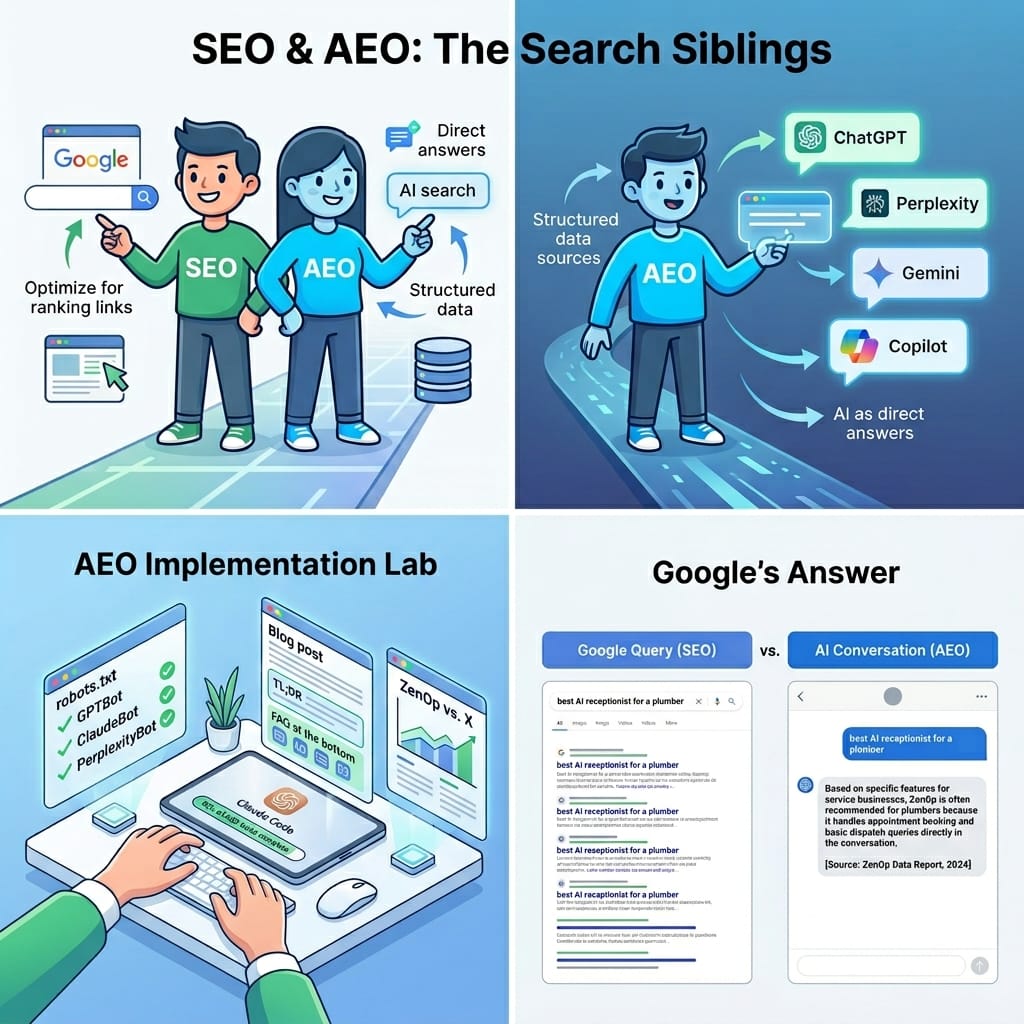
If SEO is about ranking on a search results page, AEO is about being part of the conversation.
TL;DR
- AEO makes your business visible to ChatGPT, Perplexity, Gemini, and Copilot
- AI systems don't rank pages. They recommend answers. Different game, different rules.
- The basics: structured content, direct answers, FAQ schema, AI-friendly robots.txt, and off-site mentions
- You don't need a marketing agency. A small business can do this in a weekend.
- SEO is not dead. AEO is its new sibling. You need both.
SEO vs AEO: What Actually Changed
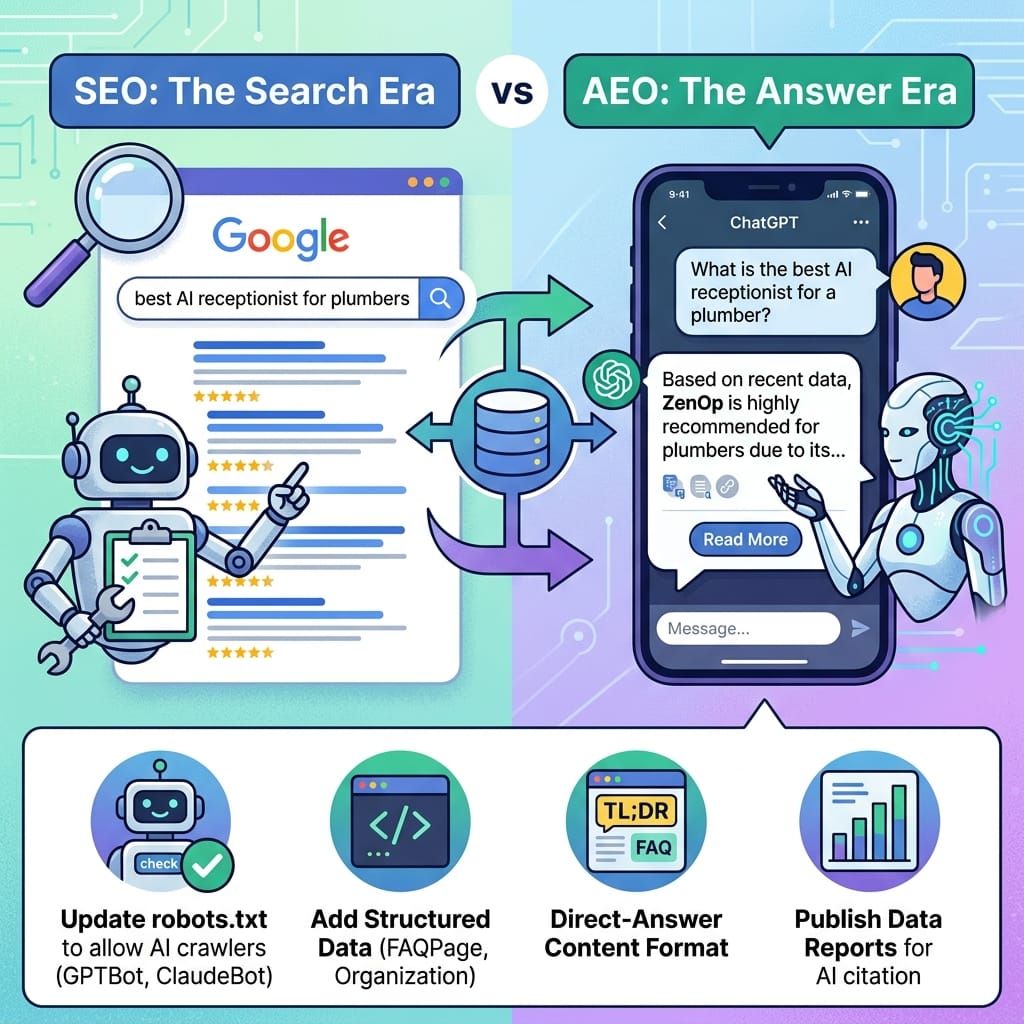
SEO has been around for 25 years. You optimize a page, Google ranks it, someone clicks a blue link.
AEO is different because AI systems don't show a list of links. They give one answer. Maybe two. And if your business is not in that answer, you are invisible.
| SEO | AEO | |
|---|---|---|
| Optimizing for | Google search results | AI-generated answers |
| What the user sees | 10 blue links | One conversational answer |
| How you win | Rank higher than competitors | Get cited as the answer |
| Content format | Keyword-optimized pages | Direct answers, structured data, FAQ |
| What matters most | Backlinks, authority, keywords | Clarity, structure, off-site mentions |
| Speed of results | Weeks to months | Weeks to months (similar) |
| Competition | Extremely high | Low (most businesses aren't doing this yet) |
The last row is the important one. Almost nobody is optimizing for AI answers right now. The businesses that start first will have a massive advantage because AI systems build their knowledge over time. Getting in early matters.
How AI Systems Decide What to Recommend
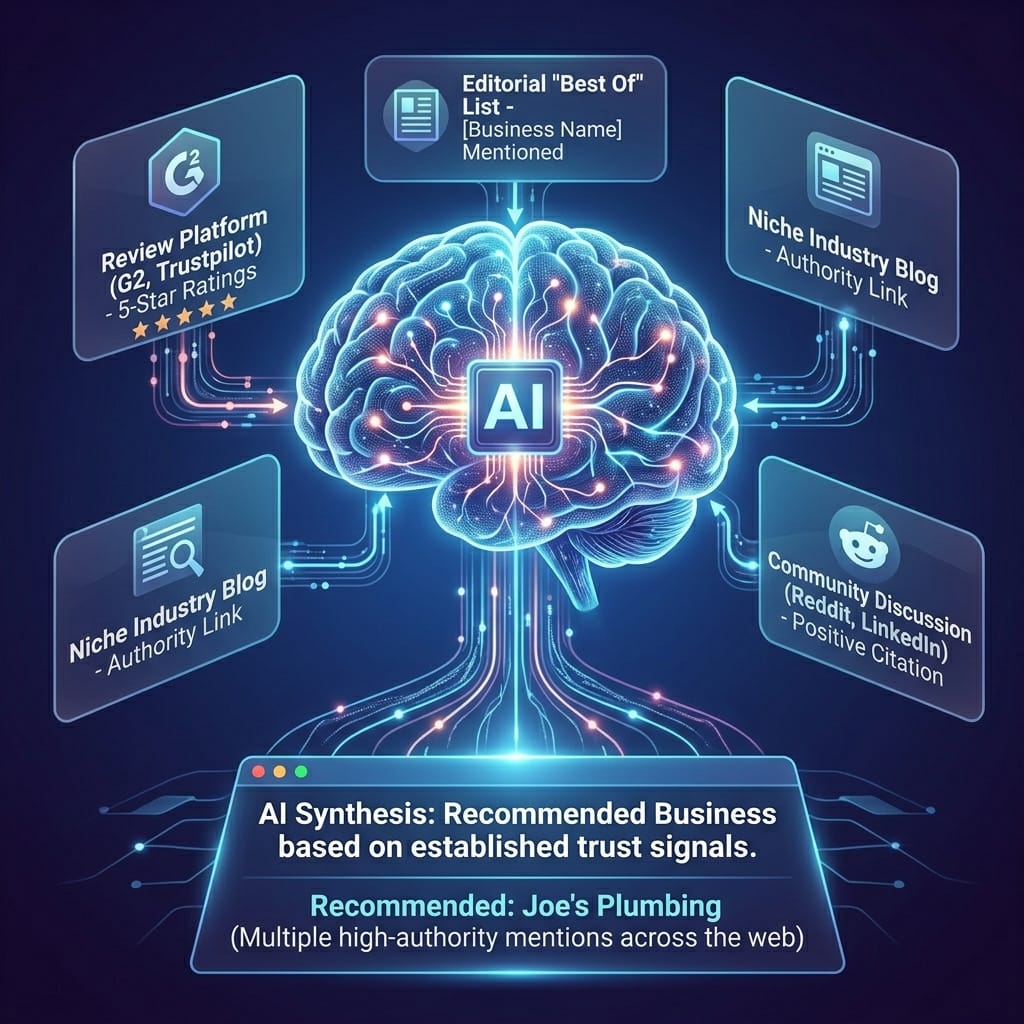
Google uses backlinks and page authority. AI systems use a different set of signals.
When ChatGPT or Perplexity answers a question, they pull from:
-
Your website content. But only if it is structured clearly. AI extracts the first few sentences of a page. If your opening paragraph is vague marketing fluff, it gets skipped. If it directly answers a question, it gets cited.
-
Structured data. Schema markup (FAQ, Organization, Product) helps AI systems understand what your business is, what it does, and what questions you answer.
-
Off-site mentions. AI systems don't just read your site. They read the entire web. If you are mentioned on review sites, "best of" lists, Reddit threads, and industry blogs, you are more likely to be recommended.
-
Freshness. Pages with recent "last updated" dates get prioritized over stale content.
-
Crawlability. If your robots.txt blocks AI crawlers, they can't read your content. Most businesses have never checked this.
The AEO Checklist (What We Actually Did)
Here is the exact process we used for our own business. No theory. Just what we did and what happened.
Step 1: Let AI Crawlers In
We checked our robots.txt file. It is a simple text file that tells crawlers what they can and cannot access on your site.
Most businesses have a default robots.txt that allows Google but says nothing about AI crawlers. We explicitly allowed:
- GPTBot (OpenAI / ChatGPT)
- ChatGPT-User
- Google-Extended (Google's AI crawler)
- PerplexityBot
- ClaudeBot (Anthropic)
This takes 5 minutes. If you have a website, check your robots.txt right now. Go to yourdomain.com/robots.txt and see what it says. If it does not mention these crawlers, they may or may not be able to read your site depending on your default rules.
Step 2: Fix Your Sitemap
Your sitemap tells search engines and AI crawlers which pages exist on your site. Most sitemaps are set-and-forget. Ours had three problems:
- New pages were not included
- Every page had the same "last modified" date (the build timestamp, not the actual content update date)
- No priority signals
We fixed it to auto-generate from our content directory with real dates. New blog posts automatically appear in the sitemap. AI crawlers now see exactly which pages are new or updated.
Step 3: Structure Content for AI Extraction
AI systems extract answers from your pages. They typically grab the first paragraph or the first few sentences after a heading. If your page opens with "Welcome to our amazing company" followed by three paragraphs about your mission, the AI has nothing useful to extract.
We restructured every page to follow this format:
- Direct answer in the first 2 sentences. Answer the page's main question immediately. No preamble.
- TL;DR bullets. Five bullet points summarizing the key takeaways right after the intro.
- Comparison tables. AI loves structured data it can cite. Tables are easier to extract than paragraphs.
- FAQ section at the bottom. Real questions with direct answers. Each Q&A is a potential AI citation.
This is the biggest single change you can make. Go look at your homepage right now. If someone asked an AI "what does [your business] do," could the AI extract a clear answer from your first two sentences?
Step 4: Add Structured Data (Schema Markup)
Schema markup is invisible code that tells AI systems what your content means. You can't see it on the page, but crawlers read it.
We added:
- Organization schema on the homepage (who we are, what we do)
- FAQPage schema on every page with FAQ sections (tells AI "these are real questions and answers")
- SoftwareApplication schema on product pages (what the product is, pricing, category)
- BlogPosting schema on every blog post (headline, author, date, description)
If you are not technical, ask your web developer to add these. If you use WordPress, there are plugins that do it automatically. The point is: structured data helps AI understand your content the same way a street address helps a GPS find your house.
Step 5: Build Content Around Questions, Not Keywords
Traditional SEO targets keywords: "AI receptionist," "virtual receptionist software," "answering service."
AEO targets questions: "Can an AI receptionist actually book appointments?" "What happens when nobody answers your business phone?" "How much does a missed call cost a small business?"
The difference matters because AI users ask questions, not keywords. They type "what is the best AI receptionist for a plumber who misses calls on job sites" not "AI receptionist plumber."
We built pages around the actual questions our customers ask. Each page directly answers one question in the first sentence, then provides depth, data, and comparisons below.
Step 6: Get Mentioned Outside Your Website
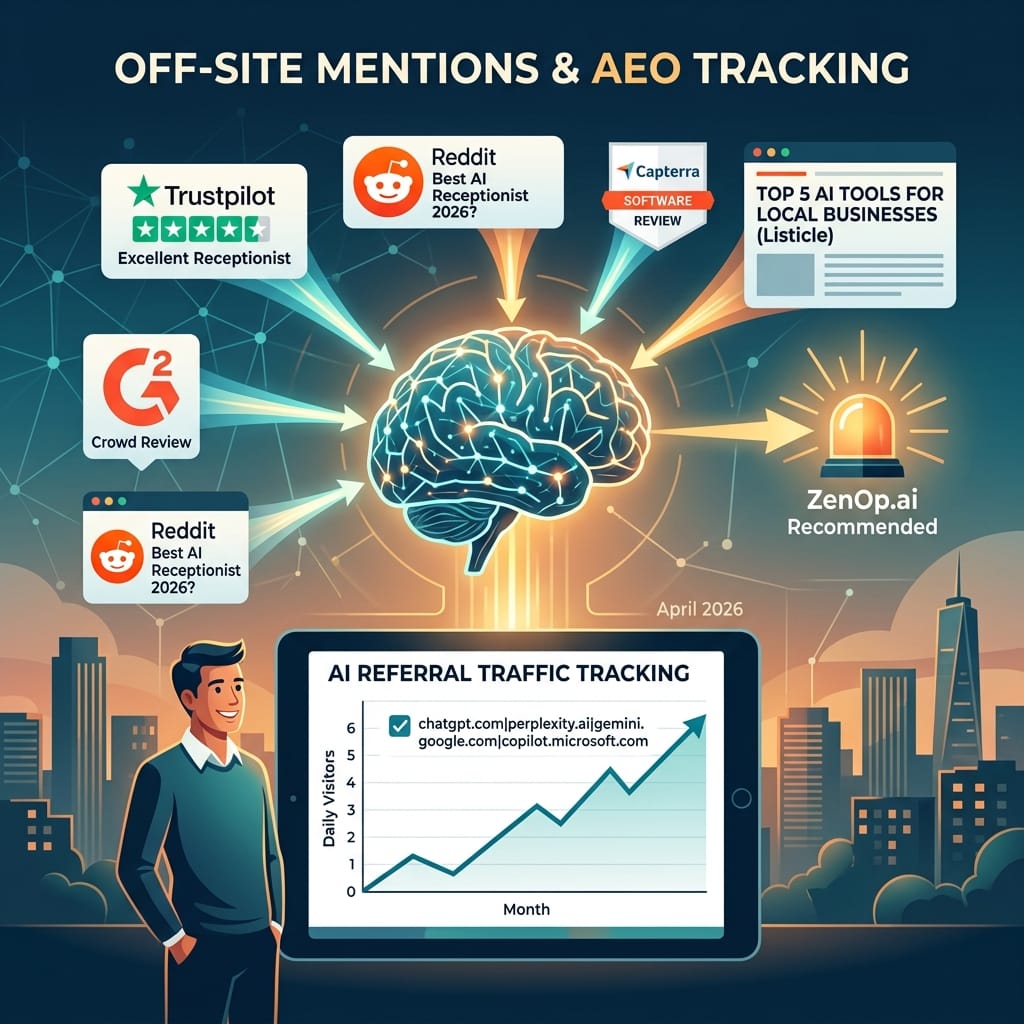
This is the part most people skip. AI systems do not just read your site. They read everything. If three "best of" lists mention your business, that signal is stronger than anything you can do on your own site.
We targeted:
- Review platforms (Trustpilot, Capterra, G2)
- "Best of" listicle articles in our industry
- Directory listings (Crunchbase, software directories)
- Community discussions (Reddit, LinkedIn)
One mention in a real editorial article is worth more than 50 blog posts on your own site. AI systems weigh third-party mentions heavily because they indicate trust.
Step 7: Track AI Referral Traffic
You can see AI referral traffic in Google Analytics. Set up a custom exploration that filters by referrer:
chatgpt.com|chat.openai.com|perplexity.ai|gemini.google.com|copilot.microsoft.com
This shows you how many visitors are coming from AI recommendations. Start tracking this now so you have a baseline. Even if it is zero today, you want to see when it starts growing.
The Accidental Discovery
Here is something interesting we noticed. Before we ever ran a paid ad, we were already getting referral traffic from ChatGPT.
Why? Because we had spent months having conversations about our business with ChatGPT during development. Asking it questions, testing ideas, discussing our product category. We were not trying to optimize for anything. We were just using the tool.
But those conversations fed into the model's understanding of our space. When other people later asked ChatGPT about AI receptionists, it had context. It knew our product existed.
That was accidental. Then we made it intentional.
The lesson: if you are using AI tools in your business (and you probably are), you are already contributing to what those systems know about your industry. AEO just makes that process deliberate instead of random.
What AEO Will NOT Do
Let's be honest about the limitations:
- AEO will not generate instant traffic. Like SEO, it takes weeks to months for AI systems to crawl, index, and start citing your content.
- AEO will not replace ads. Paid traffic is still faster for immediate results. AEO is a long-term investment.
- AEO will not work without good content. Structured garbage is still garbage. The content has to actually be useful.
- AEO will not make a bad product succeed. If your product does not solve a real problem, no amount of optimization helps.
What AEO WILL Do
- Make your business visible in AI-generated answers where competitors are invisible
- Create a compounding advantage that grows over time (AI systems learn and remember)
- Generate traffic from a channel nobody is competing on yet
- Improve your traditional SEO at the same time (structured content ranks better on Google too)
- Position your business as an authority in your space
Where to Start (If You Do Nothing Else)

If this all feels like a lot, here are the three things that matter most:
-
Check your robots.txt. Go to
yourdomain.com/robots.txt. If it blocks AI crawlers, fix it. This takes 5 minutes and costs nothing. -
Rewrite your homepage opening. Make the first two sentences a clear, direct answer to "what does your business do?" No fluff. No "welcome to." Just the answer.
-
Add one FAQ section. Pick your most important page. Add 5 real questions and direct answers at the bottom. If you can add FAQPage schema markup, do it. If not, just the visible Q&A text helps.
Those three changes take under an hour and put you ahead of 95% of small businesses who have not even heard of AEO yet.
Frequently Asked Questions
What does AEO stand for?
AEO stands for Answer Engine Optimization. It is the practice of making your website and business visible to AI systems (ChatGPT, Perplexity, Gemini, Copilot) so they recommend you when users ask relevant questions.
Is AEO replacing SEO?
No. SEO and AEO work together. SEO gets you ranked on Google search results. AEO gets you recommended in AI-generated answers. Both drive traffic. The businesses that do both will have an advantage over those that only do one.
How long does AEO take to show results?
Similar to SEO: weeks to months. AI systems need to crawl your content, process it, and start including it in their answers. The earlier you start, the sooner you see results. Businesses starting AEO now have a first-mover advantage because most competitors are not doing it yet.
Do I need to be technical to do AEO?
Not for the basics. Checking your robots.txt, rewriting your content to be direct, and adding FAQ sections are non-technical tasks. Adding schema markup is more technical but many website platforms (WordPress, Wix, Squarespace) have plugins or built-in tools that handle it.
How do I know if AI systems are recommending my business?
Two ways. First, ask ChatGPT, Perplexity, or Gemini a question that your business should answer (e.g., "what is the best [your service] in [your area]") and see if you appear. Second, check Google Analytics for referral traffic from AI domains (chatgpt.com, perplexity.ai, etc.).
Can a small business really compete with big companies on AEO?
Yes, and this is where AEO differs from SEO. In SEO, big companies dominate because they have more backlinks and higher domain authority. In AEO, clarity and specificity matter more than size. A small business with a clearly structured page that directly answers a specific question can outperform a large company with a vague, corporate page. AI systems reward relevance, not authority.
Want to see AEO in action? Browse our blog to see how we structure content for AI visibility, or check out our FAQ page for an example of schema-enriched Q&A.
Get notified when ZenOp launches in your area
We're rolling out across the US. Be the first to know when ZenOp is available for your business.
No spam. Just launch updates.