
AI Receptionist vs Virtual Receptionist: Which Is Right?
Compare AI receptionists and virtual receptionists on cost, availability, and features. Find out which phone answering solution fits your small business.
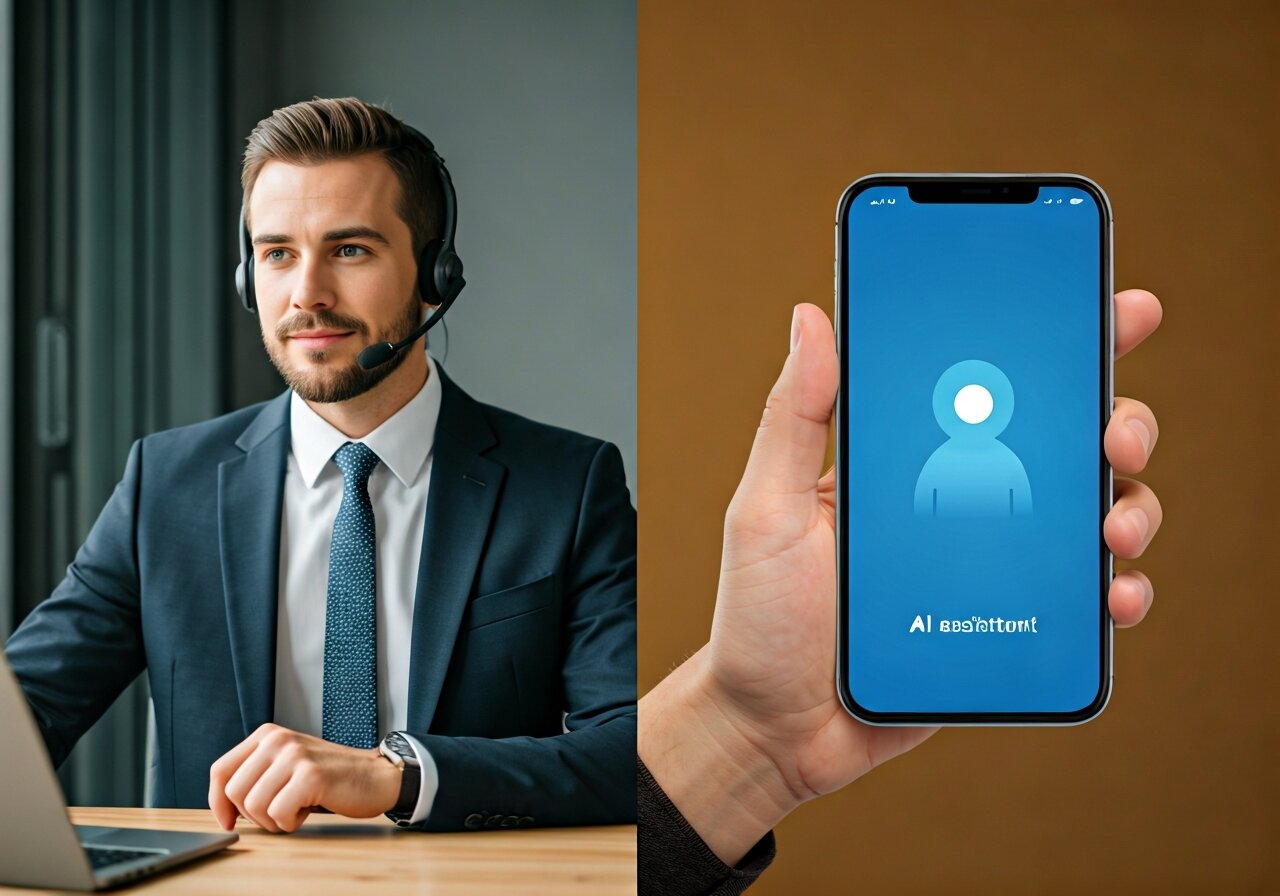
An AI receptionist is software that answers your business phone calls automatically using artificial intelligence, while a virtual receptionist is a real person working remotely from a call center. Both solve the same problem (making sure your phone gets answered), but they differ significantly in cost, consistency, availability, and how they scale. The right choice depends on your call volume, budget, and how much complexity your calls involve.
If you've been searching for help with your phones, you've probably seen both terms used interchangeably. They're not the same thing. This guide breaks down exactly how they compare so you can make a confident decision.
TL;DR
- Virtual receptionists are remote human agents. They offer natural conversation but cost $1 to $3+ per minute and have limited hours.
- AI receptionists are software. They cost a flat monthly fee, answer 24/7, and never call in sick.
- AI handles the vast majority of routine calls (scheduling, FAQs, message-taking) as well or better than humans.
- Virtual receptionists still have an edge for emotionally complex or highly unpredictable conversations.
- Many businesses start with AI for everyday calls and keep a human option for rare escalations.

What Is a Virtual Receptionist?
A virtual receptionist is a trained human agent who answers your business phone from a remote location, usually a call center. When a customer calls your number, the call routes to the agent, who greets callers using your business name and follows a script you provide.
Virtual receptionist services have been around for decades. They're essentially outsourced front-desk staff. Common providers include Ruby, Smith.ai, and Davinci Virtual.
What they typically do:
- Answer calls with a custom greeting
- Take messages and relay them via email or text
- Transfer calls to specific team members
- Handle basic intake questions
- Schedule appointments (sometimes, at extra cost)
Where they fall short:
- Availability is usually limited to business hours (evenings and weekends cost more)
- Per-minute pricing means costs climb fast with call volume
- Agent turnover at call centers leads to inconsistency
- Hold times during peak periods when agents are handling other clients' calls
- Limited language support unless you pay for multilingual plans
What Is an AI Receptionist?
An AI receptionist is software powered by conversational AI that answers phone calls, understands what callers need, and responds in a natural-sounding voice. There's no human in the loop for routine interactions. The AI handles greetings, answers common questions, books appointments, captures caller information, and routes urgent matters according to your rules.
Modern AI receptionists (like ZenOp) have moved well beyond the clunky phone trees of the past. They hold genuine two-way conversations, understand context, and adapt to what the caller is saying.
What they typically do:
- Answer every call instantly, 24 hours a day, 365 days a year
- Greet callers by your business name with a consistent, professional tone
- Answer FAQs about hours, location, services, and pricing
- Book appointments directly on your calendar
- Capture lead information and send it to you immediately
- Handle multiple simultaneous calls with no hold times
Head-to-Head Comparison
Here's how the two options stack up across the factors that matter most to small businesses.
| Factor | Virtual Receptionist (Human) | AI Receptionist |
|---|---|---|
| Monthly cost | $250 to $1,500+ (usage-based) | $30 to $200 (flat rate) |
| Pricing model | Per minute ($1 to $3/min) | Flat monthly fee |
| Availability | Business hours typical; 24/7 costs extra | 24/7/365 included |
| Hold times | Possible during peak periods | Zero. Answers instantly |
| Simultaneous calls | Limited by agent availability | Unlimited |
| Consistency | Varies by agent, shift, and day | Identical every time |
| Setup time | Days to weeks for training | Minutes to hours |
| Appointment booking | Sometimes, often an add-on | Built in |
| Emotional nuance | Strong | Improving, but limited |
| Complex problem-solving | Strong | Limited to trained scenarios |
| Languages | Usually English only; multilingual is premium | Multiple languages standard |
| Scalability | Costs scale linearly with volume | Costs stay flat |
Cost
This is where the gap is widest. Virtual receptionist services charge per minute, typically between $1 and $3. A small business taking 20 calls per day averaging 3 minutes each would pay roughly $1,200 to $3,600 per month. An AI receptionist handling the same volume costs the same flat fee whether you get 5 calls or 500.
For most small businesses, AI costs 70% to 90% less than a human virtual receptionist service. That math gets even more dramatic as your call volume grows. For a deeper cost breakdown, see our AI receptionist vs answering service comparison.
Availability
Virtual receptionists work shifts. Standard plans cover Monday through Friday, 8 AM to 6 PM. Extended hours and weekends are available but cost significantly more. AI receptionists don't have shifts. They answer at 2 AM on a holiday weekend the same way they answer at 10 AM on a Tuesday.
For businesses that get calls outside regular hours (and nearly all do), this difference alone can justify the switch. Research from Forrester has shown that 80% of callers who reach voicemail don't leave a message. Those are lost customers.
Consistency
A human agent might be having a great day or a terrible one. They might be new, or they might be juggling four other clients' calls. An AI receptionist delivers the exact same experience every single time. Your greeting, your tone, your answers to common questions. All identical, call after call.
Personalization and Complexity
This is where virtual receptionists still have a genuine advantage. Humans are better at reading emotional cues, handling angry callers with empathy, and navigating conversations that go off-script. If your business regularly deals with sensitive situations (crisis counseling, legal intake with emotional clients, complex medical triage), a human touch matters.
That said, the majority of business calls are routine. Someone wants to know your hours, book an appointment, ask about pricing, or leave a message. AI handles all of these perfectly well.
Scalability
With a virtual receptionist, every additional minute of call time costs more money. Seasonal spikes, marketing campaigns that drive calls, or simply growing your business all mean higher bills. AI receptionists handle volume spikes without any cost increase. Your 50th simultaneous caller gets the same instant answer as your first.
The Hybrid Approach
Some businesses use both. The AI receptionist handles the front line: answering every call instantly, managing routine questions, booking appointments, and capturing information. Calls that genuinely need human judgment get routed to a staff member or, in some cases, a virtual receptionist service for overflow.
This hybrid model gives you the cost efficiency and 24/7 coverage of AI with the human backup for edge cases. It's worth considering if your business handles a mix of routine and complex calls.

Decision Framework: Which Should You Choose?
Choose a virtual receptionist if:
- Most of your calls involve sensitive, emotionally complex conversations
- You need agents to perform tasks that require real-time human judgment (negotiation, detailed troubleshooting)
- Your call volume is very low (under 5 calls per day) and you want occasional human support
- You're in an industry where callers strongly expect to reach a person and won't engage with AI
Choose an AI receptionist if:
- Cost efficiency matters. You want predictable monthly pricing
- You need 24/7 coverage without paying premium rates for after-hours
- Most of your calls are routine (scheduling, FAQs, lead capture, directions)
- You get enough calls that per-minute pricing adds up fast
- You want instant answering with zero hold times
- You need to handle multiple calls at once without missing any
Consider both if:
- You have a mix of routine and complex calls
- You want AI handling the bulk of volume with human escalation for exceptions
- You're transitioning from a virtual receptionist and want to test AI before fully switching
Getting Started
If an AI receptionist sounds like the right fit, getting started is straightforward. With ZenOp, you can set up your AI receptionist in minutes. Tell it about your business, your services, and your hours. It starts answering calls immediately, 24 hours a day, with no per-minute fees.
Want to see how it works for your specific business? Book a quick demo call and hear it in action.
Frequently Asked Questions
Can an AI receptionist really replace a human receptionist?
For routine calls, yes. AI receptionists handle scheduling, FAQs, message-taking, and lead capture as well as or better than most human services. For emotionally complex or highly unpredictable conversations, humans still have an edge. Most small businesses find that 80% to 95% of their calls are routine enough for AI to handle completely.
How much does a virtual receptionist cost compared to an AI receptionist?
Virtual receptionists typically charge $1 to $3 per minute, which works out to $250 to $1,500+ per month depending on volume. AI receptionists like ZenOp charge a flat monthly fee regardless of how many calls you receive, usually saving businesses 70% to 90%.
Will callers know they're talking to an AI?
Modern AI receptionists use natural-sounding voices and hold real conversations. Some callers will recognize it as AI, but most report that the experience is professional and efficient. The key difference callers actually notice is that they never wait on hold and always get an instant answer.
Can I switch from a virtual receptionist to an AI receptionist?
Yes. The transition is simple. You set up your AI receptionist with your business details, FAQs, and scheduling preferences, then redirect your phone forwarding. Many businesses run both in parallel for a week or two to compare results before fully switching.
Does an AI receptionist work for any type of business?
AI receptionists work for any small business that receives phone calls. Service businesses, medical offices, law firms, home services, retail shops, salons, and many more. If your callers typically ask about hours, availability, pricing, or want to book appointments, an AI receptionist handles those calls effectively.
What happens if the AI can't handle a call?
Good AI receptionist services include escalation options. The AI can transfer the call to you or a team member, take a detailed message, or flag the call as urgent for immediate follow-up. You stay in control of how exceptions are handled.
Get notified when ZenOp launches in your area
We're rolling out across the US. Be the first to know when ZenOp is available for your business.
No spam. Just launch updates.